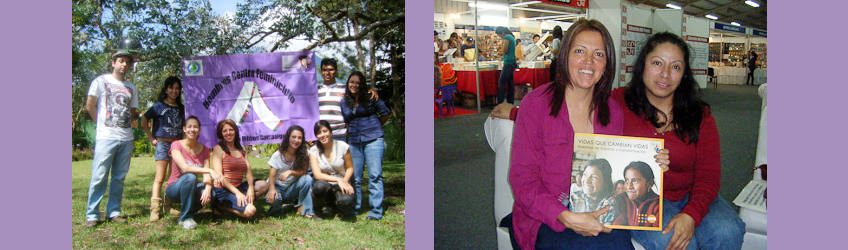
VIDEO: “From Arbenz to Zelaya: Chiquita in Latin America”
Reply

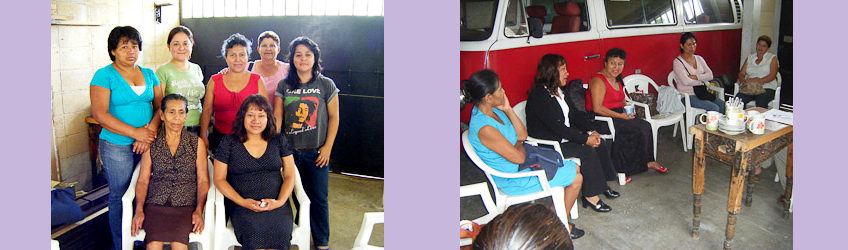
MIA worked with the widows of bus drivers killed at work. We have arranged microloans for several of the widows so they can create for themselves a way to make a living.
Our activites take us to kitchens and markets. In Guatemala, most people are more connected to food production than we are in the US.
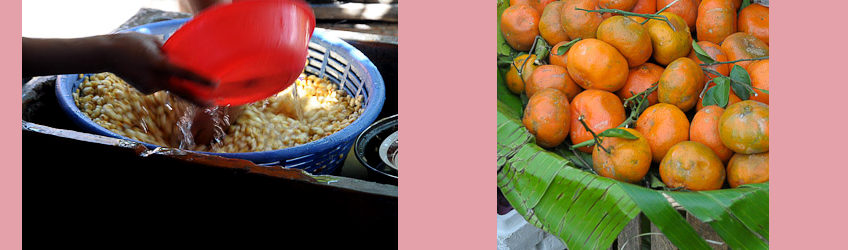
On our delegation trips, we take side trips to beautiful locations like Antigua, the old capital of Guatemala.

OPINION: Haroldo Shetemul
EL 3 DE NOVIEMBRE del 2006, una mujer desconocida secuestró a la pequeña Angiely, de dos años y medio, cuando jugaba en el patio de su casa, en Villa Hermosa, San Miguel Petapa. Desde entonces, su madre, Loyda Elizabeth Rodríguez, no ha parado de buscarla y ha hecho hasta lo imposible para poder recuperarla. En mayo del 2008, junto a otras tres progenitoras a quienes también les robaron a sus hijos, hizo una huelga de hambre frente al Palacio Nacional de la Cultura. Una semana después, la Procuraduría General de la Nación les mostró a los niños en disponibilidad de adopción. Una de las madres reconoció a su hija, pero Loyda no pudo encontrar a Angiely.
POSTERIORMENTE, cuando Loyda revisaba los expedientes del Consejo Nacional de Adopciones (CNA), se llevó una gran sorpresa. Esa institución, que había sido creada para detener las adopciones ilegales, había dado el visto bueno para la salida a Estados Unidos de una niña que tiene todas las características de Angiely. La madre asegura que la niña que aparece en esa fotografía es su pequeña hija. El único problema es que para darla en adopción, los delincuentes le cambiaron el nombre y ahora se llama Karen Abigaíl López. La niña salió del país rumbo a EE. UU., a fines del año pasado, en un proceso aprobado por el CNA.
EL PROCEDIMIENTO fue viciado. El juez de Niñez y Adolescencia de Escuintla, Mario Fernando Peralta Castañeda, no tomó en cuenta las pruebas de ADN que evidenciaban que la niña no era hija biológica de la supuesta madre, en cuyo expediente había cédulas y declaraciones falsas. Por ley, antes de declarar a una menor en estado de adaptabilidad, la foto de ésta debe ser publicada en el Diario de Centro América. En el caso de Angiely, publicaron la foto de otra niña. Para poder sacarla del país, los traficantes tramitaron un pasaporte con la foto de otra menor. En el aeropuerto nadie se dio cuenta de que la niña que salía no era la misma que aparecía en el documento. Ese procedimiento retorcido permitió que Angiely saliera del país para ser adoptada por la familia Monahan Vanhorn, en EE. UU.
ESA ES LA RAZÓN de que Loyda sea una de las madres que hacen una huelga de hambre desde hace una semana frente a la Corte Suprema de Justicia. A ella la acompañan Raquel y Olga, a quienes también les robaron a sus pequeñas hijas Cindy García (ahora llamada Cindy Colwell Thomas) y Kimberly Azucena Jiménez (Kimberly Azucena Ocheltree). Junto a ellas también se encuentra Norma Cruz, directora de la Fundación Sobrevivientes, quien les ha dado acompañamiento y exige que los procesos de adopción de esas tres menores queden sin efecto y que las niñas retornen a sus respectivos hogares en Guatemala.
LA LUCHA de estas valientes mujeres es difícil, pero debe ser apoyada por todos los guatemaltecos, ya que representa la resistencia ante las mafias que durante años han empleado los procedimientos más crueles para arrancar a niños de sus madres para obtener fuertes ganancias. Es evidente que los padres adoptivos fueron engañados por los traficantes, pero ellos deben devolver a las niñas. La huelga de hambre que llevan a cabo estas madres es un llamado de atención para que no olvidemos el dolor y la angustia que significa que secuestren a niños como parte de un negocio millonario.
Por Carlos Ibáñez
“me duelen las acciones de los malos, pero mas me duele el silencio de los buenos”
Norbert Wiener
Hablar de la Trata de Personas dentro del contexto de las migraciones en ahondar en dos fenómenos distintos que en algún momento confluyen en tiempo, espacio y protagonistas.
Actualmente no existe país en el mundo que se encuentre libre de la presencia de fenómenos migratorios o de alguna de las modalidades de la Trata. Ya sea porque son países expulsores, de tránsito o receptores de migrantes ínter fronterizos o porque tienen esos movimientos dentro de su jurisdicción. En muchos casos, como en la situación particular de Guatemala, coexisten las tres.
Cuando se profundiza en las causas que originan la movilidad de las personas y las situaciones que vulnerabilizan a las personas para ser potenciales víctimas de trata, encontramos situaciones comunes. Ayer mismo escuchaba a la directora de una organización decir que el enemigo no es únicamente el tratante, sino también las condiciones sociales y estructurales que facilitan que las personas sean vulnerables a los mecanismos de captación y explotación que definen la trata.
Si bien anteriormente esta situación era conocida como trata de blancas por ser precisamente mujeres blancas europeas que eran llevadas con fines de explotación sexual hacia países de Europa del Este, Asia y África, actualmente esta situación ha cambiado haciendo de cualquier persona puede ser potencialmente una víctima de trata en cualquiera de sus modalidades: explotación sexual, explotación laboral, adopciones irregulares, mendicidad, comercio de órganos, matrimonios serviles, entre otras.
Aún antes del inicio del viaje, los tratantes han establecido sus redes como mecanismos de captación, falsas promesas de trabajo, estudios, mejores condiciones de vida se convierten en los ganchos con los cuales atraen potenciales víctimas, muchas veces con la ayuda de la misma familia o amigos. Durante todo el camino, los migrantes están propensos a ser captados por las redes existentes, quienes creando deudas de viaje, coartando la libertad, bajo amenazas, engaños o violencia entre otras, le convierten en víctimas Independientemente de la modalidad, la sutileza o la crudeza con la cual se manejen sus características, la trata constituye una acción que violenta el bienestar de las personas que son víctimas de ella y deja secuelas que deben ser atendidas para asegurar su salud y bienestar, dentro de espacios sociales que brinden seguridad y respeto.
Al desarraigar a una persona de su lugar habitual, limitarle su libertad y explotársele para beneficios económicos de terceros, se le está afectando no solo física sino también en los aspectos emocionales impidiéndole tener el pleno control de sus vidas. Esta situación es una clara violación al derecho a una vida digna, acorde con la calidad humana que nos corresponde intrínsecamente.
La explotación sexual comercial (el turismo sexual, la pornografía infantil, la prostitución forzada), el trabajo forzado ya sea agrícola, manufacturero o de cualquier otra índole, la mendicidad, las adopciones irregulares, el matrimonio servil, el comercio de órganos humanos, son algunas de las modalidades bajo las cuales muchas personas se convierten en víctimas de trata de manera cotidiana, ante la mirada muchas veces indiferente de los espectadores para quienes esa persona es “culpable de su situación”.
La lucha por evitar que más personas sigan siendo víctimas de trata, el rescate y atención a quienes ya se encuentran inmersas en ellas y la persecución penal de los tratantes, requiere de acciones conjuntas entre organizaciones que ya trabajan el tema de manera directa y aquellas que atienden a poblaciones susceptibles de ella. Implica también el reconocimiento del problema mismo y de sus diferentes modalidades junto con la visibilización pública del problema.
Ante esto necesitamos un estado que asuma responsablemente su deber de velar por pleno desarrollo de las personas. Un estado decidido a desarrollar las acciones de prevención, y atención de víctimas. Un estado que cumpla con su función tutelar de velar por el respecto de los derechos humanos de todas las personas. Así como, un estado que realice la persecución legal necesaria y aplique sanciones que realmente disuadan de continuar en esa actividad a los tratantes.
A la vez necesitamos una sociedad civil mas proactiva y articulada en el combate a la trata, que a la vez se constituya en monitora de las acciones del estado, y en observadora del fenómeno para advertir cualquier modificación que se de en sus mecanismos de captación, traslado, acogida o explotación de las víctimas.
Pasar al lado con esa mirada indiferente y actitud culpabilizadora es algo que debe quedar en el pasado y en lugar de ello, la eliminación de toda modalidad de trata de personas, debe ser parte de nuestro actuar en la búsqueda del desarrollo humano de la persona.
…
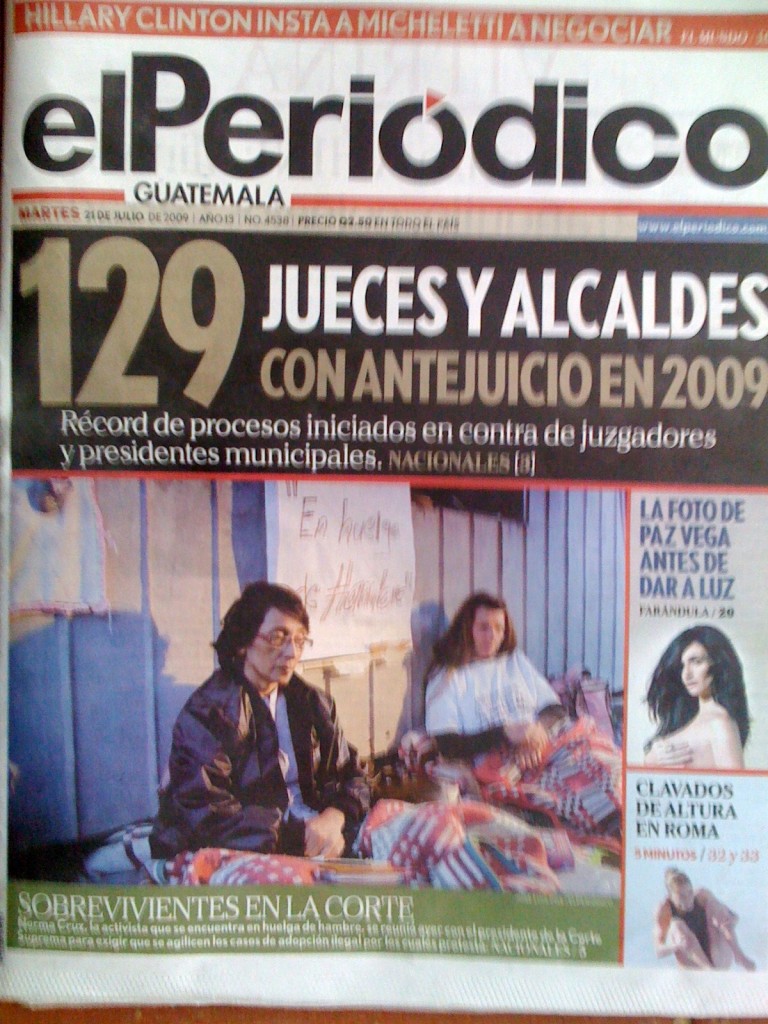
Cover picture in El Periodico, Guatemala, of Norma Cruz during a hunger strike demaning the return of Guatemalan children illegally adopted in Guatemala by U.S. families.
Alisa Aydin, New York — UNICEF USA
 Malnutrition is an underlying cause in more than half of the 25,000 daily, preventable deaths of children.
In Guatemala, where rising food prices are compounding the problem, UNICEF is using another innovative solution to help save children’s lives: “Sprinkles.”
Known as “Chispitas” in Latin America, Sprinkles are a unique way of getting vulnerable children the nutrients they need to survive and thrive. A blend of micronutrients—like iron, vitamin A, vitamin C, zinc and folic acid in powder form—Sprinkles come in small packets (much like sugar packets) and are easily sprinkled on food at home.
And best of all, kids like ’em.
UNICEF’s Next Generation leads the charge
UNICEF’s Next Generation is a group of young professionals chaired by Jenna Hagar Bush—former First Daughter, UNICEF intern and author of Ana’s Story: A Journey of Hope. (Check out her first-hand reports from Peru on the Fieldnotes blog.)
Committed to reaching a day when zero children die from preventable causes, UNICEF’s Next Generation has pledged to raise $175,000 to support UNICEF’s Sprinkles program in Guatemala.
You can help by spreading the word, learning more about the importance of nutrition for child survival, or making a gift today.
http://www.unicefusa.org/news/news-from-the-field/fighting-malnutrition-with.html
By Tim Padgett Monday, Jul. 20, 2009
It’s been five centuries since Pedro de Alvarado, a homicidal Spanish conquistador, seized from the Maya the volcanic realm that became Guatemala. But his bloodlust still haunts the country, which today has one of the highest homicide rates in the western hemisphere. Guatemala’s 36-year-long civil war, which ended in 1996, killed 200,000 people. Its cloak-and-dagger murders have made locals so paranoid that “even the drunks are discreet,” as one 19th century visitor wrote.
That neurosis still shrouds Guatemala City, a gloomy capital that no amount of marimba music can brighten. Rich and poor communities alike are surrounded by walls topped with enough razor wire and rifle-toting guards to look like penitentiaries. This year tandem motorcycle-riding was banned because it was such a popular M.O. for drive-by shootings, and daylight saving time was canceled because the dark mornings created too many opportunities for foul play. Even so, bus drivers face being killed by armed extortionists during rush hour, and lawyers who complain about government corruption can turn up under the bougainvilleas with a few bullets to the head.
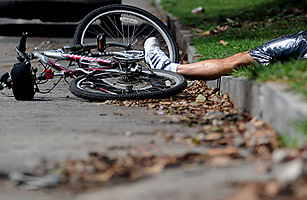
That’s apparently what happened to Rodrigo Rosenberg, a corporate lawyer murdered on May 10 while biking near his home. In a twist that’s macabre even for Guatemala, Rosenberg had taped a video three days earlier in which he anticipated his assassination and put the blame on President Alvaro Colom and his imperious wife Sandra Torres. They deny it, saying their right-wing foes coerced Rosenberg into making the video and then had him killed.
But since the shocking video was uploaded to YouTube on May 11, the nation has begun to confront the benighted lawlessness that plagues not only Guatemala but most of the rest of Central America too. Younger Guatemalans, organizing protests via social-networking sites such as Facebook and Twitter, have turned out by the thousands to protest their putrid judicial system and festoon Rosenberg’s murder scene with banners. “Older people say they haven’t seen an awakening like this in 60 years,” says Alejandro Quinteros, 26, a cherubic fast-food manager and political novice who helps lead the National Civic Movement. “We’re not afraid anymore.”
Fear is understandable in a country that feels like a “baroque game of chess played with bodies,” says Francisco Goldman, whose book The Art of Political Murder details the 1998 assassination of Catholic bishop Juan Gerardi, who was bludgeoned to death after issuing a report on army massacres during the civil war. In a nation where just 2% of last year’s 6,200 murders were solved, “impunity opens doors to murderous imaginations,” says Goldman.
But the outcry over the Rosenberg case has opened doors to reform. Guatemala’s congress was compelled to pass a law, long resisted by powerful political and business interests, that allows public scrutiny of judicial appointments. This month lawmakers say they’re set to convene at least one special session to act on measures such as concealed-weapons laws and the creation of organized-crime and anticorruption courts. Activists like Alfonso Abril, 24, of the civic group ProReforma, want to revise Guatemala’s sclerotic constitution to modernize lawmaking and codify individual rights. “I’m from the upper class,” says Abril, “but I know we can’t keep living in a country like this.”
He also knows Guatemalan politics is still treacherous. More than 50 candidates were assassinated during the general election in 2007, the same year three visiting Salvadoran congressmen were murdered by rogue policemen (who were then mysteriously killed themselves). In his video, Rosenberg says his coffee-baron client Khalil Musa was gunned down along with his daughter in April because Musa knew too much about drug-money-laundering. “Rodrigo wanted to talk about the deadly manipulation of laws and lives here,” says his half brother Eduardo Rodas. Guatemala has asked the U.N. and the FBI to investigate his murder. After 500 years, Rosenberg’s ghost may be the first to challenge Alvarado’s.
http://www.time.com/time/magazine/article/0,9171,1909604,00.html
Justine reports:

Thursday morning, MIA went to San Carlos University where Lucia gave a presentation on  MIA’s Hombres Contra Feminicidio program at a gender equity conference.
We then went to the National Police Archives and got a tour from Alberto Fuentes. The  archives contain approximately 80 million documents of accounts of human rights violations from the government that occurred during Guatemala’s 30-year civil war, including accounts of illegal detentions, illegal prisons, and tortures, among others. Though the Guatemalan government claimed that these documents did not exist, they were found only in July of 2005, when military officials inspected a munitions dump after an explosion occurred.
The documents, which were found in a decaying building and covered with mold, rats, and  bugs, have since been moved into the National Police Archives Building.
There, they have established a system in which to clean, organize, and digitize the documents, of which we were able to witness the processes during our tour. Benetech, a nonprofit organization from Silicon Valley, California, has assisted the Guatemalan investigators through providing means by which to scan and  analyze the documents. Thus far, they have found that at least 15% of these accounts showed evidence of human rights abuses. Though nothing can be done to reverse the anguish that the country suffered during the civil war, finding and
honoring the cases contained in the  archives may help victims and families heal the wounds of injustice that were brought on by the war.
We then drove to Café Artesana, an activist, art, and learning center near the Palacio Nacional. It is directed by Sandra Moran, a well-known political and feminist activist in Guatemala,  who was a member of the Sector de Mujeres (women’s sector) that pushed for the inclusion of gender equity in the 1996 peace accords. Though included in the accords, gender equity has yet to be implemented – that is where Moran, along with many others, comes into the picture.
The goal of Sandra Moran and Café Artesana is a world in which women and men are able to live without violence. The Café the project of a women’s collective comprised of feminists and feminist artists, and is a space for art, expression, and freedom for women and men, without any fear of racism, sexism, or discrimination.
One of Café Artesana’s current focuses is working with women in jail, helping women use art as a tool to reflect on and empower their lives.
We had a lengthy discussion with Moran about current Guatemalan and U.S. politics, the newly instituted but rarely implemented Femicide Law, and the overall situation of women in Guatemala. After days of what has seemed like a crash course in government corruption, impunity, and institutionalized violence against women, it was a much-needed breath of fresh air to hear an optimistic glimpse from Moran as our discussion ended. Reiterating that her goal for the state of women in Guatemala would probably never be reached in her lifetime, and acknowledging that despite the hardships she and other activists face, we must keep in mind that the small victories, such as the establishment of Café Artesana, are the base  for the bigger, revolutionary changes. Justice and equality is a day-to-day struggle, Moran said, but with enough commitment and patience, eventually the moment will come when our work will lead to positive change.
 Katherine reports:
Wednesday morning we spent time supporting Fundacion Sobrevivientes and the hunger strike they are doing to bring home the three Guatemalan children who were sold into illegal adoptions. Norma Cruz, the founder of Sobrevivientes, is leading the strike along with several mothers of the kidnapped children, as well as Shyrel Osborn, an American who moved to Guatemala 13 years ago as a missionary and started a home for children who have no other place to go. The strike started at 9am sharp and drew a crow of reporters and supporters in front of Guatemala City’s courthouse. We all received  t-shirts with the phrase:
Enterremos Juntos
La corrupcion
La impunidad
Y La injusticia
Which translates into English as,
Together we will stop
The corruption
The impunity
And the injustice.
While wearing our shirts we held the banners for Hombres Contra Feminicidio (MIA’s chapter of the universal White Ribbon Campaign), and the Guatemala Peace and Development Network, which was also co-founded by Lucia and is the proud big sister of MIA.
 Two of the three families that have illegally adopted the children have been notified of the circumstances under which they received the children, and one has vowed to fight until the very end to keep the child, while the other has gone into hiding so as not to lose the baby.
Lots of pictures were taken throughout the morning and several crews filmed us. Many people walked trough our demonstration on their way to or from the courthouse, so we hopefully got the message across. We were able to use the restrooms in the courthouse, but we had to take the t-shirts off before they would let us in.
After the day’s activities we went back to the strike for a few hours to show our support. The demonstration had been moved to a tent under an awning on the concrete square in front of the Palacio de Justicia (Plaza of Justice), a very ironic title given the state of justice in Guatemala. The media was gone, as were many of the supporters from the morning. People gathered in small groups to chat or make a trip to the Burger King across the square to use the restrooms.
Human trafficking is not a new issue for Guatemala, especially the illegal adoption industry. We hope for the sake of the people not eating and for the families involved that these children will be brought back to their home where they belong. Bringing these children back would be a great start to fighting this illegal industry and asserting the basic human rights of the Guatemalan people to the world.
Marlene Reports:
 The MIA delegation met with Ana Moraga, the director of MuJER, a non-profit organization that aims to empower sex workers in Guatemala City. Ana gave an overview of the different services that MuJER provides. For instance, the organization puts on workshops that address several critical issues, such as self-esteem building and protection from violence. Furthermore, MuJER offers classes that provide skills training for sex workers in several areas. These classes include cosmetology, computers, English, and primary education. One of the more popular classes shows the women how to make jewelry that they can sell to supplement their income.
In addition to discussing MuJER’s activities the group also addressed sex workers’ current situation. Three women that have benefited from MuJER’s work were part of the discussion and graciously answered our questions. Among several themes that emerged from the discussion was sex workers’ vulnerable status in the country. The Department of Health regulates the sex work trade, although sex work itself is illegal. A recent human trafficking law meant to protect children and youth prohibits sex work in bars and brothels, which had previously offered a minimal level of protection. Therefore, sex workers are in a precarious position due to the clandestine nature of their work.

Another theme that came up and that demonstrates another level of vulnerability is the fact that about 60% of sex workers that MuJER works with are not Guatemalan citizens. Most are migrants from Honduras, El Salvador, and Nicaragua. These women often lack documentation that allows them to remain legally in Guatemala. Furthermore, officials continually demand to see a work visa which migrant sex workers cannot obtain since their trade is illegal. Therefore, officials subject sex workers to arbitrary and discriminatory policies since they do not have any kind of legal protection.
In a country where women as a whole have a subordinate position in society, sex workers are among the most marginalized group at both the social and economic levels. Two of the women who visited us were single mothers. They were forced to take sole responsibility for their children’s welfare after their husbands abandoned the family. One of the women emphasized that she had tried to work as a waitress but simply could not make ends meet with the dismal salary that the job provided. By choosing to work in this sexual commerce, these women engaged in one of the more economically viable options available to them, which brings us to one of MuJER’s key objectives, which is to provide skills training that simultaneously empowers women. MuJER emphasizes that sex work is a choice. The women, due to a range of circumstances, weighed their options and decided that sex work was the choice that worked for them at these particular moments in their lives. Therefore, while the organization teaches them skills that could eventually lead to alternative employment strategies (all three women brought jewelry they designed and the delegates went on a mini shopping spree!), it simultaneously promotes the development of self-awareness and stresses women’s autonomy.
Katherine reports again:
 Wednesday evening before dinner, Carlos Ibanez, an expert on human trafficking in Guatemala, joined us at our hotel to give a brief overview of the trafficking infustry in Guatemala.
There are three main characteristics of human trafficking: 1) loss of freedom and liberty, 2) others gaining from one’s exploitation, and 3) the trafficked person is taken from their native culture and home. Currently, 7,000 Guatemalan children are being trafficked and sexually exploited.
The laws and justice systems of many countries have not caught up to this issue of modern day slavery, and Guatemala is no exception. Only recently have they adopted a law against trafficking, and there is yet to be a case taken to court using the new law. Many people in Guatemala, as well as the anti-trafficking community, agree that it is not the law itself that will make a difference, but rather the enforcement of the new law that will being an end to trafficking.
Because of Guatemala’s unique location, sharing borders with four other nations and between two oceans, Ibanez emphasized that it is an ideal place for traffickers to target their victims.
Many people play a role in the trafficking of humans, so cracking down is often a long and sometimes complicated process. Understanding the various roles and how we as U.S. citizens benefit from the trafficking is crucial to understanding how to fight smugglers and end human trafficking.
 At the beginning of the day, MIA received visits from two surviving parents of murdered women. The first parent who visited us was Rosa Franco, whose daughter Maria Isabel was killed in 2001, at age 16. Maria Isabel worked in a clothing store and noticed a man that seemed to have been stalking her on numerous occasions. One night, leaving from work, she was abducted and forced into a car, and was severely beaten, raped, and left in a ditch to die.
Maria Isabel, a beautiful young woman, enjoyed wearing makeup and cute clothing. This, according to the public defense attorney, meant that she must have been a prostitute. After over a year of frustrating attempts to further her daughter’s case, Amnesty International helped Franco get her case into the InterAmericas  Court. While Franco says that Amnesty International was helpful pushing her case, she said that that the IAC had its own special political interests connected to Guatemala and thus failed to push a legitimate investigation of her daughter’s murder. As a result of Franco’s determination to obtain justice for Maria Isabel, she has been subjected to various threats and the IAC has provided her family with its own security. Without any satisfactory progress to note, Franco is still trying to push her daughter’s investigation, much to the displeasure of the Guatemalan government, she noted.
Shortly after, Jorge Velazquez met with MIA to discuss the murder of his daughter Claudina,  who was raped and murdered while walking home from a party. In a similar fashion to Maria Isabel’s case, Claudina’s murder was delegitimized by the police and the public defense attorney. They insisted that she must have been a prostitute due to the facts that she was wearing sandals, a choker necklace, had a navel piercing, and her body was found in a middle class neighborhood. Consequently, as a “prostitute,” her case was not worth investigating.
Claudina’s fingerprints were not taken at the crime site or at the morgue. The police immediately covered her body, even before the crime scene investigators arrived. There were also major discrepancies surrounding her time of death. Velazquez has been trying to push his daughter’s investigation for several years to no avail, but believes that his daughter’s brutal murder is a result of the reality that narcotic traffickers often use women as tools in their  transactions, what is believed to be a major factor of violence against women in the country. While Velazquez and his family have not been able to obtain justice to perhaps ease the healing process, he aspires for a Guatemala in which impunity does not exist to further the pain that families of victims of violence must endure.
The personal testimonies of Rosa Franco and Jorge Velazquez left a heavy air in the room; several of us were in tears. Such tragic accounts, however discouraging as we realized the magnitude of impunity that too often overpowers women’s cases, gave us even further inspiration for the cause to which we have become dedicated.
 public university in Guatemala. Randi and Jenny, who are long-time friends of MIA, gave us a presentation along with the rest of their on-campus activist group, Collectivo Rogelia Cruz. Giving a thorough and accurate history of the country, they discussed the military coup in 1951 that was aided by the United States and put Jacob Arbenz in power, leading to the 30-year old civil war that began in 1960 and, despite the signing of peace accords in 1996, continues to haunt Guatemala. The group also presented on the student movement that arose in the 60’s and 70’s as a result of the massive inequalities that ensued as a result of war and contributed to society’s overall resistance to the political climate.
  As the student movements began at this very university, Collectivo Rogelia Cruz gave us a tour of the incredible murals around campus that serve as both intricate works of art and heartfelt accounts of the country’s history.
(more to come)
Katherine reports:
Wednesday morning we spent time supporting Fundacion Sobrevivientes and the hunger strike they are doing to bring home the three Guatemalan children who were sold into illegal adoptions. Norma Cruz, the founder of Sobrevivientes, is leading the strike along with several mothers of the kidnapped children, as well as Sheryl Osborne, an American who moved to Guatemala 13 years ago as a missionary and started a home for children who have no other place to go. The strike started at 9am sharp and drew a crow of reporters and supporters in front of Guatemala City’s courthouse. We all received t-shirts with the phrase:
Enterremos Juntos
La corrupcion
La impunidad
Y La injusticia
Which translates into English as,
Together we will stop
The corruption
The impunity
And the injustice.
While wearing our shirts we held the banners for Hombres Contra Feminicidio (MIA’s chapter of the universal White Ribbon Campaign), and the Guatemala Peace and Development Network, which was also co-founded by Lucia and is the proud big sister of MIA.
Two of the three families that have illegally adopted the children have been notified of the circumstances under which they received the children, and one has vowed to fight until the very end to keep the child, while the other has gone into hiding so as not to lose the baby.
Lots of pictures were taken throughout the morning and several crews filmed us. Many people walked trough our demonstration on their way to or from the courthouse, so we hopefully got the message across. We were able to use the restrooms in the courthouse, but we had to take the t-shirts off before they would let us in.
After the day’s activities we went back to the strike for a few hours to show our support. The demonstration had been moved to a tent under an awning on the concrete square in front of the Palacio de Justicia (Plaza of Justice), a very ironic title given the state of justice in Guatemala. The media was gone, as were many of the supporters from the morning. People gathered in small groups to chat or make a trip to the Burger King across the square to use the restrooms.
Human trafficking is not a new issue for Guatemala, especially the illegal adoption industry. We hope for the sake of the people not eating and for the families involved that these children will be brought back to their home where they belong. Bringing these children back would be a great start to fighting this illegal industry and asserting the basic human rights of the Guatemalan people to the world.
Marlene Reports:
The MIA delegation met with Ana Moraga, the director of MuJER, a non-profit organization that aims to empower sex workers in Guatemala City. Ana gave an overview of the different services that MuJER provides. For instance, the organization puts on workshops that address several critical issues, such as self-esteem building and protection from violence. Furthermore, MuJER offers classes that provide skills training for sex workers in several areas. These classes include cosmetology, computers, English, and primary education. One of the more popular classes shows the women how to make jewelry that they can sell to supplement their income.
In addition to discussing MuJER’s activities the group also addressed sex workers’ current situation. Three women that have benefited from MuJER’s work were part of the discussion and graciously answered our questions. Among several themes that emerged from the discussion was sex workers’ vulnerable status in the country. The Department of Health regulates the sex work trade, although sex work itself is illegal. A recent human trafficking law meant to protect children and youth prohibits sex work in bars and brothels, which had previously offered a minimal level of protection. Therefore, sex workers are in a precarious position due to the clandestine nature of their work.
Another theme that came up and that demonstrates another level of vulnerability is the fact that about 60% of sex workers that MuJER works with are not Guatemalan citizens. Most are migrants from Honduras, El Salvador, and Nicaragua. These women often lack documentation that allows them to remain legally in Guatemala. Furthermore, officials continually demand to see a work visa which migrant sex workers cannot obtain since their trade is illegal. Therefore, officials subject sex workers to arbitrary and discriminatory policies since they do not have any kind of legal protection.
In a country where women as a whole have a subordinate position in society, sex workers are among the most marginalized group at both the social and economic levels. Two of the women who visited us were single mothers. They were forced to take sole responsibility for their children’s welfare after their husbands abandoned the family. One of the women emphasized that she had tried to work as a waitress but simply could not make ends meet with the dismal salary that the job provided. By choosing to work in this sexual commerce, these women engaged in one of the more economically viable options available to them, which brings us to one of MuJER’s key objectives, which is to provide skills training that simultaneously empowers women. MuJER emphasizes that sex work is a choice. The women, due to a range of circumstances, weighed their options and decided that sex work was the choice that worked for them at these particular moments in their lives. Therefore, while the organization teaches them skills that could eventually lead to alternative employment strategies (all three women brought jewelry they designed and the delegates went on a mini shopping spree!), it simultaneously promotes the development of self-awareness and stresses women’s autonomy.
Katherine reports again:
Wednesday evening before dinner, Carlos Ibanez, an expert on human trafficking in Guatemala, joined us at our hotel to give a brief overview of the trafficking infustry in Guatemala.
There are three main characteristics of human trafficking: 1) loss of freedom and liberty, 2) others gaining from one’s exploitation, and 3) the trafficked person is taken from their native culture and home. Currently, 7,000 Guatemalan children are being trafficked and sexually exploited.
The laws and justice systems of many countries have not caught up to this issue of modern day slavery, and Guatemala is no exception. Only recently have they adopted a law against trafficking, and there is yet to be a case taken to court using the new law. Many people in Guatemala, as well as the anti-trafficking community, agree that it is not the law itself that will make a difference, but rather the enforcement of the new law that will being an end to trafficking.
Because of Guatemala’s unique location, sharing borders with four other nations and between two oceans, Ibanez emphasized that it is an ideal place for traffickers to target their victims.
Many people play a role in the trafficking of humans, so cracking down is often a long and sometimes complicated process. Understanding the various roles and how we as U.S. citizens benefit from the trafficking is crucial to understanding how to fight smugglers and end human trafficking,


 Proud Founder Member of the Guatemala Peace and Development Network