Fiscalía recibe al menos 600 denuncias mensuales

Diario La Hora — Nacionales
Violencia: Agresiones a mujeres se investigan poco
Gerson Ortiz / lahora@lahora.com.gt

De más de 600 casos que ingresan a la fiscalía de la mujer del Ministerio Público, un promedio de 1 por ciento ha concluido en una sentencia condenatoria.

De más de 600 casos que ingresan a la fiscalía de la mujer del Ministerio Público, un promedio de 1 por ciento ha concluido en una sentencia condenatoria.

La Fiscalía de la Mujer del Ministerio Público (MP) recibe más de 600 denuncias mensuales sobre casos de violencia sexual; sin embargo, la impunidad es característica también en estos casos.
De un total de 3 mil 401 denuncias ingresadas de enero a mayo del año en curso, sólo 68 de los sospechosos de agresión han sido enviados a la cárcel; la Fiscalía ha solicitado 224 órdenes de captura de las que 156 están pendientes ejecutar.
El clima de violencia contra las mujeres se torna complejo ya que a criterio de analistas, la cantidad de efectivos policiales para brindar atención a las víctimas es insuficiente, a ello se suma la falta de investigadores y, por ende, de una efectiva persecución penal contra los agresores; lo que genera un alto porcentaje de desistimientos por parte de las propias agredidas.
IMPUNIDAD
Blanca Sandoval, titular de la Fiscalía de la Mujer explicó que el trabajo de la institución está en “realizar una investigación responsable y determinar la existencia o no del delito, posteriormente si se establece que hubo delito se procede la solicitud de aprehensión”, indicó.
Respecto a los escasos resultados en las pesquisas, la investigadora indicó que el principal obstáculo en muchos de los casos “es la propia víctima que está envuelta en el círculo de la violencia y no se da cuenta del riesgo que corre delante del agresor y permanece con él, desistiendo de todas las acciones que ha iniciado”, declaró; y agregó que la Fiscalía se ve afectada por los desistimientos y la falta de acompañamiento dentro del proceso y en el debate.
Sandoval explicó que la Fiscalía cuenta con los recursos para documentar el hecho, tomar fotografías (en casos de violencia física) y de realizar informes médico forenses y sicológicos que ilustren el daño que la víctima ha sufrido, desde que esta se presenta a poner la denuncia. La Fiscal agregó que las principales víctimas de violencia sexual son las mujeres, las niñas y los niños.
PUNTO DE VISTA
Javier Monterroso, analista del Instituto de Estudios Comparados en Ciencias Penales, opinó que la principal causa de la impunidad es la falta de investigación: “los casos de delitos sexuales requieren una investigación científica mayor a la delitos comunes, ya que se necesitan analizar fluidos, ADN, sangre, huellas dactilares; entre otras pericias científicas que el país capacidad de hacer”.
Monterroso agregó que, aunque Inacif ha avanzado en ese tema, el MP no solicita en muchos casos las pruebas necesarias para fundamentar una investigación.
A criterio de Monterroso existe incapacidad del MP para darle seguimiento a los casos, pero enfatizó que se necesita una Policía de investigación criminal que haga las pericias necesarias en los casos de delitos sexuales: “debería existir una unidad de investigación, dentro de la PNC que se especialice en indagar delitos sexuales.
El analista dijo finalmente que “de la víctima no depende el impulso del proceso” y que es el MP el que debe seguir la denuncia independientemente que la víctima quiera o no. Además, indicó que existen otras vías como las salidas negociadas, que podrían contemplar que el agresor se sometiera a tratamientos, conciliara con la víctima y reparara el daño, enfatizó.
COMPLEJIDAD
Norma Cruz, Directora de la Fundación Sobrevivientes, opinó que la cultura del miedo por medio de las amenazas e intimidaciones son las que generan el arrepentimiento de las víctimas en cuanto al seguimiento de los casos abiertos.
Cruz describe con complejidad la situación: “Una gran limitante es que en la Policía Nacional Civil es insuficiente para brindar protección a las mujeres víctimas, eso hace que no acudan de forma inmediata cuando estas necesitan el auxilio; al mismo tiempo genera que los agresores estén en la calle atemorizándolas y por ello prefieren dejar a un lado la denuncia”.
Para Cruz, cada mujer que rompe el silencio debería contar con un agente de la PNC que la cuide; y agregó que en muchos casos, los agresores están mejor armados que la propia Policía “hay casos de agresores que andan con AK 47 y son parte de grupos del crimen organizado”, expresó.
ESTADÍSTICAS
• Aproximadamente 600 denuncias mensuales ingresan al MP, las principales víctimas son mujeres, niñas y niños.
• De un total de 3 mil 401 denuncias recibidas de enero a mayo, sólo 68 agresores están en prisión preventiva.
• De 224 órdenes de captura que ha solicitado la Fiscalía en 2009, 156 están pendientes ejecutar.
• El MP ha logrado siete sentencias condenatorias por violencia contra la mujer en procedimiento común y abreviado.
http://www.lahora.com.gt/cmmn/notasprn.php?key=51713

In New York, Number of Killings Rises With Heat

By ANDREW W. LEHREN and AL BAKER

Interactive feature: http://projects.nytimes.com/crime/homicides/map

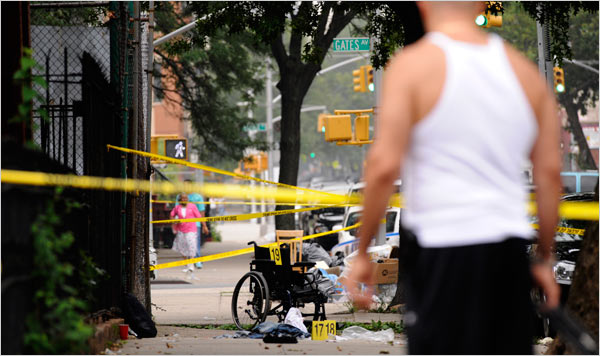
A murder scene at Gates Avenue and Patchen Avenue in Bedford-Styuvesant, Brooklyn, in July 2008. Robert Stolarik for The New York Times.

A young boxer was shot dead outside a Bronx bodega at 3:30 a.m. on a Saturday last August. Weeks later, a 59-year-old woman was beaten to death on a Saturday night on the side of a Queens highway. On the last Sunday in September, violence exploded as five men were killed in a spate of shootings and stabbings between midnight and 6 a.m.

Seven homicides in New York City. None connected in any way but this: They happened during the summer months, when the temperatures rise, people hit the streets, and New York becomes a more lethal place.

There were more homicides in September than in any other month last year: 52. Next highest was August, with 51. Variations, of course, exist. There were 48 homicides last March, for instance.

Still, the prime time for murder is clear: summertime. Indeed, it is close to a constant, one hammered home painfully from June to September across the decades. And the breakdown of deadly brutality can get even more specific. September Saturdays around 10 p.m. were the most likely moments for a murder in the city.

The summer spike in killings is just one of several findings unearthed in an analysis by The New York Times of multiyear homicide trends. The information — detailing homicides during the years 2003 to 2008 — was compiled mainly from open-records requests with the New York Police Department, and a searchable database of details on homicides in the city during those years is available online for readers to explore at nytimes.com/nyregion.

Of course, the dominant and most important trend involving murder in New York has been the enormous decline in killings over the last 15 years, to levels not seen since the early 1960s.

Still, hundreds of people are killed every year in the city, and The Times’s findings provide insights about who is killed in New York, as well as who does the killing, where murders occur and why.

Women, for instance, are less likely to be either victims or killers. Those who were killed — at least 73 women were in 2008 — were almost always murdered by someone they knew — boyfriends, husbands or relatives. From 2003 to 2008, the number of women killed each year by strangers was in the single digits — excluding cases in which the police do not know if the killer knew the victim. Last year, as few as eight women died at the hands of strangers.

Brooklyn — as it has since at least 2003 — led all boroughs in the number of homicides last year, with 213. Last year, the 73rd Precinct, which includes the neighborhoods of Ocean Hill and Brownsville, had the largest death toll, 31. The bloodiest block in Brooklyn was in the 77th Precinct, in Crown Heights, bounded by Schenectady Avenue, Sterling Place, Troy Avenue and St. Johns Place. But the borough with the most homicides per capita was the Bronx.

More often than not, the weapon of choice is a firearm. Each year the percentage of people killed by firearms hovers around 60 percent. Though slightly less than in recent years, at least 56 percent of last year’s homicides were committed with these weapons.

Of all the trends to emerge, the time for killing was among the most enduring.

In New York, the trend goes back well before the years covered in the database — at least as far as 1981, according to an analysis of reports by the city medical examiner’s office done by Steven F. Messner, a criminology professor at the State University of New York at Albany. And he believes it stretches back much further than that.

Nationally, in the early 1980s, scientists at the Centers for Disease Control and Prevention analyzed a decade’s worth of homicide data across the nation, and found that while suicides peak in the spring, homicides swell between July and September.

A prime reason murder peaks during this time has to do with the routines of people’s lives, according to Professor Messner. “Homicides vary with social acting,” he said. “It evolves from interactions.”

Summer is when people get together. More specifically, casual drinkers and drug users are more likely to go to bars or parties on weekends and evenings, as opposed to a Tuesday morning. These people in the social mix, flooding the city’s streets and neighborhood bars, feed the peak times for murder, experts say.

And the trend occurs in other cities, in places like Chicago, Boston and Newark, according to criminologists.

Some of the same trends are on display around Christmastime and are believed to be behind the slight increases in murder that occur then, criminologists say.

Thomas D. Nerney, who retired in 2002 as a detective in the New York Police Department’s Major Case Squad, said the patterns were well known within the department.

Assigned as a detective in Brooklyn from 1972 to 1986, he said that on a hot summer night or in the holiday season, a similar set of factors seemed to be behind the killings: a chance to socialize and to drink or use drugs.

He recalled the late 1970s and early ’80s in Brooklyn, when the heavier homicide caseloads seemed to come as neighborhoods got hotter.

“We had so many of them,” Mr. Nerney said. “They would be on rooftops. There might be somebody who lured someone somewhere; you would have a sex-related killing or a revenge killing. Rooftops or backyards.”

The Times analysis, when compared with Professor Messner’s findings from 1981, shows that increasingly, more victims were killed between midnight and 8 a.m. in recent years than in the past.

According to the professor’s study of homicides in Manhattan, 29 percent of the 1,826 victims in 1981 were killed between midnight and 8 a.m. More recently, from 2006 through 2008, 39 percent of all homicide victims were killed during those hours, the Times analysis shows.

Also, as the number of homicides has shrunk, the data shows that more are occurring on weekends. From 2003 to 2008, 36 percent of all victims were killed on Saturday or Sunday, the analysis shows.

Failing to understand the basic connection between time of year and homicide rates can lead law enforcement agencies to faulty conclusions about what is happening in the streets — and it can affect their strategies.

In St. Louis, a 1990s-era gun buyback program begun each fall was thought by some to be behind a drop in violence. But as Richard Rosenfeld, a professor of criminology at the University of Missouri, St. Louis, studied the program’s impact, he found that the annual crime reductions were more attributable to the normal seasonal ebbing in homicide and assaults.

In New York, Vincent Henry, a retired police sergeant who now teaches criminology and who has studied the department’s Compstat program, in which computerized data is used for more efficient policing, said that time was one of many factors in making decisions about staffing and when and how to deploy officers.

But that was not always the case.

In the early 1990s, police managers altered the working hours for various groups of detectives, including those tracking narcotics cases and those seeking to arrest criminals wanted on open warrants.

It seemed to the top officials at the time that too many officers were keeping bankers’ hours — ending their shifts at dusk and taking weekends off — and not working closely enough with counterparts.

Jack Maple, a former police deputy commissioner who helped develop Compstat, wrote a book, “The Crime Fighter,” in which he detailed the issues of the day. He described the shortfall this way: “Unfortunately, the bad guys work around the clock.”

And in the summer months, the bad guys tend to be deadliest.

http://www.nytimes.com/2009/06/19/nyregion/19murder.html?_r=2

Bullets don’t stop Guatemala green activist

FOREIGN EXCHANGE / L.A. Times

Yuri Melini was shot seven times by an assailant nine months ago. The outspoken champion of environmental causes has made many enemies, and gained recognition too.

By Ken Ellingwood

Reporting from Guatemala City — His stride is an awkward hop, the scars on his abdomen and legs an ugly road map of hurt. Seven bullets tore into Yuri Melini — that much is known.

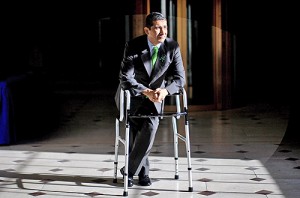
Dr. Yuri Melini who was awarded the Frontline Protection of Human Rights Defenders Award, is seen in Dublin City Hall, Ireland on May 8.

Harder to figure out is who did it. Melini has a lot of enemies.

Drug traffickers. Midnight loggers. Mining giants. Corrupt military men. Politicians. The 47-year-old Melini has taken on all of them as lead agitator of a Guatemalan environmental advocacy group, the Center for Legal, Environmental and Social Action, or CALAS.

Melini doesn’t seem surprised that police have yet to come up with a solid lead into September’s shooting by a lone gunman. Or that telephone threats and sightings of shadowy men haven’t stopped.

He opts for the bright side. “I’m alive,” Melini says.

If you think it’s not easy being green, try doing it in a place as violent as Guatemala, where environmentalism is often viewed as a radical pursuit and the rule of law remains a distant goal. Speaking out can bring a hit man to your door.

For the last nine years, Melini has spoken out a lot. Using a mix of grass-roots activism, lawsuits and old-fashioned lobbying, his organization tackles issues from illegal logging in protected forests and the impact of a growing mining industry to the supply and cleanliness of water.

Guatemala has plenty of other grave social problems, poverty and inequality among them. But Melini, who gave up his training as a physician to focus on conservation causes, says his environmental work ties into a wider effort to improve life for the powerless, including the country’s large indigenous population.

“There are enough laws — the problem is they are not being applied,” Melini says, as government-supplied bodyguards wait outside his office in Guatemala City, the capital. “It is a matter of awareness and will: raising the awareness of the people and the will of the politicians.”

Big triumphs have been few for CALAS, with a staff of 21 lawyers, engineers, agronomists, sociologists and other experts.

But a major victory came last June, when the group won a Supreme Court of Justice ruling that struck down parts of the nation’s mining law as too lax. CALAS had argued in its legal challenge that the law didn’t adequately safeguard people living near mining operations.

Melini has done battle with oil firms and gone to court to challenge a decision to allow logging in a mountain forest designated for protection.

In addition, he has complained loudly about damage caused by drug traffickers in a vast wilderness in the northern province of Peten, where smugglers fell trees to build secret airstrips and roads. This year, CALAS is to open its first offices in the region, home to some of its toughest fights and most dangerous adversaries.

Such crusades don’t always charm. Melini acknowledges that even some environmentalists consider him too strident. He relies on foreign sources for funding, with most coming from a special environmental program of the Dutch government.

But admirers say Melini is breaking new ground by carrying environmental fights to the courtroom — a tactic that is common in the United States but not in Guatemala or much of the surrounding region. Melini says he wants to create a legal-aid network devoted to environmental issues and to lobby for creating special environment courts.

“Environmental litigation across Central America is still not very common,” said Erika Rosenthal, an attorney for the Oakland-based group Earthjustice. “That kind of advocacy . . . is sorely needed.”

Last month, Melini was honored by the Irish-based human rights group Front Line for his efforts on illegal logging and mining issues. The group cited his attempts to bring attention to attacks on environmental activists. (He counted 128 during two years.)

Melini was ambushed outside his mother’s house Sept. 4 by a gunman who fired from close range. The activist said he lay curled on the ground, awaiting the coup de grace, but the attacker left.

Nine months later, Melini gets around with a walker and faces more surgery. He’s had residency offers from several countries, including Switzerland and the Netherlands, but refused. He figures fleeing Guatemala would serve those behind the attack on him, whoever they are.

“I am like a tree,” Melini says. “They chopped me down, and I’m bouncing back again.”

ken.ellingwood@latimes.com

http://www.latimes.com/news/nationworld/world/la-fg-guatemala-enviro11-2009jun11,0,3203312.story

Femicide in Guatemala and Ciudad Juárez: The Underlying Causes that Have Spurred an International Phenomenon

By Samantha Serrano

On average, two women are killed every day in Guatemala. At least 4,000 women have been murdered in the Central American country since 1999. (1) More than 500 women have been slain in Ciudad Juárez, Mexico since 1993. (2) This city is often referred to as the City of Lost Girls. Many activists believe the statistics the Mexican government admits are very conservative and the number of women killed is more likely in the range of 4,000 to 6,000. (3)

What is just as staggering as the volume of murders in the two regions is the manner in which many of the women are killed. Women’s corpses in both areas of Latin America are found mutilated, strangled, burned, decapitated, raped, and abused. Bodies have been found with skulls crushed in, fingernails pulled backwards, wrapped in barbed wire, or with the word venganza (Spanish for vengeance) carved into the body with a knife. (4)

The term used to define such high numbers of violent homicides of women is femicide. According to Diana Russell, the author of Femicide in Global Perspective, femicide is not simply the murder of females, but rather “the killing of females by males because they are female.” (5) I believe that the presence of machismo and impunity in both Ciudad Juárez and Guatemala, paired with independent historical and contemporary tensions within each region, have fueled the two epidemics of femicide. This situation has instigated a cry for both women’s rights and human rights.

In many people’s minds, machismo walks hand-in-hand with Latin American culture. Machismo is an overemphasized masculinity centered on the domination of women. (6) This is typical in patriarchal societies where violence against women has become a cultural norm and an accepted custom for centuries. Machismo is present in both Guatemala and Ciudad Juárez and has been established since the time of the Spanish conquest.

When the Spanish settled in Central and South America, they brought every aspect of their culture with them, including how they treated women. Spain, although it is rapidly changing, has historically been a patriarchal society in which men controlled women. In patriarchal societies, women serve as bearers of children and housewives while remaining financially dependent upon men. In patriarchal societies men dominate both politics and households. (7)

The societal belief that women are inferior to men promotes violence against women, just because they are women. Psychologically it becomes a man’s right in a patriarchal society to invade a women’s body through rape, other forms of violation, or murder. Machismo promotes a need to exterminate or dominate uncontrollable women to maintain patriarchal systems. The result of the need for male dominance that causes some men to murder women is femicide.

For many men in Ciudad Juárez and Guatemala, machismo is a cultural norm and for some men being macho is a good thing. Macho is often understood as being a term used to describe an honorable man or a good provider for one’s family.

Sociologist David T. Abalos believes that many Latino men have internalized the deception that Spaniards, other Europeans, and white Americans are inherently better than Mestizos. Abalos says that the Mestizo men of places like Mexico and Guatemala internalize this notion and continue to comply with how society expects them to behave. The inherited idea of male dominance, which culturally appears to be the only place Latino male’s power remains, translates into a manifestation of violence towards women in order to maintain control. If a woman attempts to become more independent and this dominance fractures, feelings of insecurity and inferiority arise and a man is more likely to become violent toward the women in order to regain power. (8)

Machismo also continues to be a norm in contemporary Latin American society due to the fact that the majority of police officers and officials running the justice system are men. Often times in both Ciudad Juárez and Guatemala when women file complaints that their husbands have abused or raped them, the police officers do not get involved and tell the woman that the dispute should be left between her and her husband.

Machismo within the justice system is one of the factors that cause impunity for crimes against women. Considering the lack of laws for women’s protection from violence, the unwillingness or ignorance of a majority of the people involved in the justice system, and the lack of training and supplies for crime investigators and prosecutors, impunity for men who commit femicide seems almost positive.

Of the 1,500 women that were assassinated between 2003 and 2007 in Guatemala, only 14 cases ended in a prison sentence. (9) Only one percent of the cases involving femicide in Ciudad Juárez have resulted in prosecution and sentencing. (10) Low rates of prosecution and sentencing found in both Ciudad Juárez and Guatemala send a clear message to potential assassins that they can and will get away with murder.

In both Guatemala and Ciudad Juárez authorities are quick to blame gang violence and prostitution for unsolved murders involving both men and women. (11) The former President of Guatemala, Oscar Berger, said in June 2004 that in a majority of cases involving femicide, “the women had links with juvenile gangs and … organized crime,” although he did not site any evidence to support that.

In 1995, the Chihuahua State Assistant Attorney General blamed women of Ciudad Juárez who worked all day and then went out dancing and drinking all night for the femicide. He said they invited rape and murder and the large number of assassinations was their fault for going out alone and not holding to the societal expectations of women. Government officials placed ads throughout the city that said, “Do you know where your daughter is?” That same year, fifty-two women were murdered in the city, which was the highest number up until then. (12)

Most police and crime scene investigators in both Guatemala and Ciudad Juárez lack proper training to solve cases. In Ciudad Juárez evidence is often mishandled. Police investigators have misidentified bodies and have given some victims’ families remains of the wrong victims. Some crime scene investigators do not use gloves to handle evidence and do not use bags to place and transport evidence.

In Guatemala femicide victims’ families have reported that victims’ clothes are often returned to them rather than kept as evidence, and DNA testing is not done. Despite the existence of an anti-kidnapping squad in Guatemala, police customarily stall searches until three days after a person is reported missing.

One of the reasons officers are so poorly trained is their low wages. Both the Mexican and Guatemalan government fail to allocate enough money to pay officers adequate salaries. To make up for their low wages, police and government officials in both regions often take bribes as well. Bribes to traffic officers are as customary as highway tolls. Officers and other officials can be bribed to tamper with evidence or ignore a crime. (13)

The laws in both Mexico and Guatemala have done little to protect women from domestic abuse and rape. Both domestic abuse and rape have been linked to female homicides. Until late 2006 in Guatemala, a rapist could legally escape charges if the father permitted him to marry his victim and she was at least 12 years old. (14) Domestic violence cannot be prosecuted unless signs of injury are still apparent 10 days later and marital rape is not a criminal offense. A law empowering men to prohibit their wives from working outside the home was revoked only in 1999. (15)

Women in Mexico cannot file domestic abuse charges if their injuries take less than fifteen days to heal. If a rape victim is twelve years of age or older and a proven prostitute, there can be no charges filed against the perpetrator because authorities consider the victim an active participant. If it is believed that a rape victim led the attacker on and then refused to have sex, the perpetrator will only have to serve one to six years in prison. Forced penetration by anything other than a penis is not considered an act of rape in Mexico. (16)

Although femicide in both Guatemala and Ciudad Juárez can be credited largely to machismo and impunity, both regions have independent factors and histories that have helped catalyze the two separate epidemics. Guatemalans took in a thirty-six year civil war that included the largest per-capita genocide ever experienced in independent Latin American history. The people of Ciudad Juárez have experienced a radical change in the labor force from male domination to female due to the development of maquiladoras.

Mass murders, rape, and torture are not new to Guatemala. An American-organized rightist military coup violently overthrew the government of the elected president, Juan Jacobo Arbenz, when he tried to initiate land reform in 1954. The coup led to more than three decades of civil war between the army and left-wing guerrillas. Before it ended in 1996, more than 200,000 were killed. A large percentage of the victims in Guatemala were indigenous people slain by the army in a government-mandated genocide. A United Nations-sponsored truth commission calculates that the army is responsible for more than 90 percent of the killings during the civil war. (17)

During the civil war, women were seen as spoils of the battles that soldiers could use however they wished. Women made up about a quarter of those killed during the war, although they almost never participated in fighting or politics. Rape was often used as a scare tactic and a display of power by the military. Soldiers or paramilitaries would often cut fetuses from the wombs of victims because they claimed the unborn babies were potential rebels. Violence against women today seems to be a continuum of the violence committed during the war. Many of the people considered responsible for the random murders, rapes, and genocide during the war have taken on positions of power in post-war Guatemala. Some of their jobs include politicians, police officers, and high-ranking officials in the military. Former dictator Efrain Rios Montt ruled during perhaps the most violent time of the civil war and perpetuated the genocide of the indigenous people between 1982 and 1983. Rios Montt became a member of congress both during the war and after the peace accords were signed between 1990 and 2004. After instigating riots in the streets of Guatemala City in 2003, he was able to run for President. Thankfully, he lost by a landslide. (18)

Even though Rios Montt is currently on trial in Spain for human rights violations during the war, his lasting effect on Guatemala’s post- peace accord government exemplifies how the violence of the war is engrained in present-day Guatemala. According to Guatemalan-American artist and radio producer Ana Ruth Castillo, “A lot of violence was taught, indoctrinated, and institutionalized (during the civil war), and I think that our generations now are still victims of that and have not been able to heal from that.” (19)

The violent society that the people became accustomed to living in during the war is still thriving today. In spite of the 1996 peace accords, Guatemala has one of the worst homicide rates in the world. The fact that victims of femicide are often killed in the same ways they were killed during the war is proof of the lasting impression the violence of the war has left. As women attempt to gain more rights and change society in post-war Guatemala, they not only face machismo, but they also battle for rights against politicians and officers who formerly instigated genocide and used rape as a weapon. To several of these men, women’s rights are not an option. Women who seem to challenge traditional gender roles by working, wearing sandals, drinking alcohol, or having a belly button ring are often victims of femicide. (20) Castillo explained, “Because violence is so cyclical between families and partners it has gone past the civil war and it is still very present.” (21)

The women of Ciudad Juárez live in distinctly different conditions from those of the women in Guatemala. Ciudad Juárez is the Mexican city across the border from El Paso, Texas. Since the U.S./ Mexican border was established, there has been great economic disparity between the two cities. Ciudad Juárez has inherited violence due to the ongoing battle to bring illegal drugs into the United States across the border. The drug wars in 2008 put death tolls at record highs. One aspect of border towns that many people overlook, however, is the maquiladora.

Maquiladoras are factories set up by foreign companies (mostly American) in Mexican border towns. Maquiladoras were rare until the Mexican government launched the Border Industrialization Program (BIP) in 1965 to bring business and employment back to the border cities after World War II. (22) The BIP granted licenses to foreign companies (mostly from the United States) for the tariff-free importation of machinery, parts, and raw materials. The surge of foreign factories marshaled in the maquiladoras. The businesses that came to Mexico, however, did not desire male workers. They desired female workers because they were more docile, submissive, and cheaper than male workers. When the Mexican government passed the BIP they unintentionally converted Mexican border towns into manufacturing sectors. Migrant workers from rural areas rushed to the border towns seeking employment at the maquiladoras. The flow of discouraged migrants seeking employment, as well as transient workers hoping to hop the border to the U.S., resulted in over-crowding of the city and a high crime rate.

Skyrocketing female employment and plummeting male employment changed the makeup of the workforce in Ciudad Juárez. Female maquiladora workers became the main wage earners in the home. Although women seemed to achieve greater financial independence, husbands, fathers, and brothers did not normally allow women to play a significant role in household decisions. In actuality, the switch to women becoming the main breadwinners in the home caused most men to tighten their control over women. The typical male usually refused to resign from his position as head of the household and would not help with housework or cooking. Female maquiladora workers had to take on the responsibilities of cooking, cleaning, and taking care of the children in addition to a ten-hour workday. (23)

In 1993, the corpses of young females started appearing in the deserts on the outskirts of Ciudad Juárez. Before 1993 most murders in Ciudad Juárez were drug and gang-related. However, the majority of the victims found at this point had no relation to either gangs or drugs. (24)

As the bodies began emerging, tensions concerning male domination and employment were gaining momentum due to the upcoming passage of the North American Free Trade Agreement (NAFTA), which would further empower the maquiladoras and augment female employment.

The passage of NAFTA in 1994, which allows for an economic open trade policy between the United States, Mexico, and Canada, caused a renewed surge of maquiladoras in Juárez, as predicted. More than 400 maquiladoras now operate in Ciudad Juárez and continue to produce billions of dollars in exports. Young women from other parts of Mexico migrate to the already overpopulated Ciudad Juárez hoping to find economic security in Juárez’s maquiladora job market. (25)

Thousands of young women in Ciudad Juárez commute to maquiladora jobs every day before sunrise to work ten to twelve hour shifts where they will be lucky to make $5 a day. The women often have to walk in dangerous areas with little outdoor lighting in the shantytowns outside of Ciudad Juárez to arrive at the nearest bus stop to get to work. A 20-year-old woman named Claudia Ivette once arrived three minutes late for her shift at a maquiladora and was turned away into the dark night. Her body was later found in a ditch alongside the corpses of eight other women. (26)

With increased employment tensions and women forced into unsafe situations to keep employment at the maquiladoras, femicide in Ciudad Juárez has escalated. Last year saw the highest number of victims of femicide, with eighty-six women’s bodies found. (27) More than fifty percent of femicide victims are maquiladora workers.

Maquiladoras also illustrate the cultural idea of female disposability. (28) This disposability refers to the excessive turnover rate of employees in the maquiladoras. Another reason maquiladora managers prefer to hire women is because they are less likely to strike. Women in maquiladoras can be fired for any reason. If a woman does not meet the company’s weekly goals of production or if a woman gets pregnant it is automatic grounds for termination. Women’s activist Esther Chávez claims that the attitudes of maquiladora managers toward female workers with regards to their disposability have permeated the minds of the men of Ciudad Juárez. They take on the belief that the bodies and lives of women are also disposable. (29)

Maquiladoras promote segregation and competition between men and women in the work place as well. Maquiladora managers separate the sexes in the workplace. When male workers do not meet the maquiladora’s standards or are disobedient, they are forced to sit with the female workers as a penalty.

The tactics used by the maquiladora manager give the male workers a feeling of superiority. When they are “punished” by having to sit with the women, they feel their masculinity is threatened. This could result is a violent reaction towards the women they are forced to be in the company of.

Perpetrators of femicide also have an advantage in that many of the maquiladora workers are transients from other parts of Mexico. (30) It is not likely that victims with few or no ties in the area will be searched for. Several women’s remains are found in the deserts on the outskirts of Ciudad Juárez that are never claimed or identified. If there is no one battling for a murder case to be solved in Ciudad Juárez, officials do not bother with an investigation. (31)

The exact causes or motives in each case of femicide in Guatemala and Ciudad Juárez will never be known. One would have to question the murderers of the more than 3,000 woman in Guatemala and 500 women in Ciudad Juarez. However, one can be sure that the presence of impunity for the perpetrators of femicide as well as the cultural acceptance of male domination over females, or Machismo, has played a role in or contributed to the killers’ willingness and desire to take the lives of innocent women. The scars of civil war and genocide in Guatemala, as well as indoctrinated violence, have contributed immensely to the contemporary epidemic of femicide. The defensive reaction to the change in employment in Ciudad Juárez due to the maquiladoras, as well as the anonymity and disposability of such a large portion of the female population, has contributed to the motives behind femicide in the border town.

As more and more bodies turn up in both regions, more and more men and women join the fight against femicide. There is an ongoing battle by Nongovernmental organizations, concerned citizens, and victims’ families and friends against the acceptance of femicide and the murderers. (32) They claim that although more men are murdered than women in both Ciudad Juárez and Guatemala, people must take into account the way these women are killed. While men are normally just shot or stabbed, women are raped and then seriously mutilated. The manners in which the women are murdered exhibit hatred towards the female sex that is also apparent in how women are treated while they are alive. The fight against femicide is a fight for the rights of all women, dead or alive.

As Guatemalan sociologist Ana Silvia Monzón said, “We have to recuperate the feeling of living, of living well…. We are not able to continue in this dynamic of poverty, of discrimination, of racism, and of machismo that only brings us destruction.” (33)

Sam Serrano is currently earning her M.A. in Latin American Studies at the University of Texas at Austin. Sam graduated from California State University of Fullerton in May 2009 with a double major in Spanish and Latin American Studies and a minor in Journalism. She plans to continue her work for human rights in Guatemala throughout the rest of her career.

……………………………………………………………………..

(1, 33) Ana Silvia Monzón, personal communication, December 14, 2008

(2, 6, 8, 10, 12, 13, 16, 22, 23, 24, 26, 28, 29) Panther, 2007
(3) Gwin, 2008
(4, 7, 20, 32) Lucia Muñoz, personal communication, December 19, 2008

(5) Russsell, 2001
(9, 11) Lakshmanan, 2006

(14) Benitez, 2007
(15) Impunity Rules 40-42

(17) Tuckman, 2007

(18) Aznarez, 2008
(19, 21) Ana Ruth Castillo, personal communication, December 14, 2008

(25, 30, 31) Osborn, 2004
(27) Washington Valdez, 2009

Bibliography

Gwin, Sara (2008, February 19). Alarming rates of femicide in Latin America. Oregon State U, Retrieved April 18, 2009, from http://global.factiva.com.lib-proxy.fullerton.edu/ga/default.aspx

Russell, Diana (2001). The Politics of Femicide. New York: Teachers College Columbia University Press.

Panther, Natalie (2007). Violence against women and femicide in Mexico: The case of Ciudad Juarez. The Humanities and Social Sciences Collection, Retrieved April 18, 2009, from http://www.proquest.com.lib-proxy.fullerton.edu

Lakshmanan, Indira A. (2006, March, 30). Unsolved Killings Terrorize Women in Guatemala. Boston Globe, Retrieved April 19, 2009, from http://proquest.umi.com.libproxy.fullerton.edu/pqdweb?did=1012172451&Fmt=3&VInst=PROD&VType=PQD&RQT=309&VName=PQD&

Benitez, Ines (2007, November, 26). Right- Guatemala: Impunity Fuels Violence Against Women. NoticiasFinancieras, Retrieved April 19, 2009, from http://proquest .umi .com .lib -proxy .fullerton .edu/pqdweb ?did=1388399061 &Fmt=3 &clientId=17846 &RQT=309 &VName=PQD

Tuckman, Jo (2007, May, 10). An untold massacre. ail & Guardian Online , Retrieved April 21, 2009, from http://global.factiva.com.lib-proxy.fullerton.edu/ga/default.aspx

(2006, November 18). Impunity Rules. Economist, 40-42.

Aznarez, Juan Jesus (2008, February, 13). The killing fields of Guatemala. El Pais , Retrieved April 21, 2009, from http://global.factiva.com.lib-proxy.fullerton.edu/ga/default.aspx

Washington Valdez, Diana (2009, January, 26). U.N. official to visit slain women’s families in Juárez. El Paso Times, Retrieved April 16, 2009, from http://www.elpasotimes.com/ci_11559343

Osborn, Corie (2004, March, 1). Femicidio, hecho en Mexico. Off Our Backs, 24, Retrieved April 22, 2009, from http://global.factiva.com.lib-proxy.fullerton.edu/ga/default.aspx

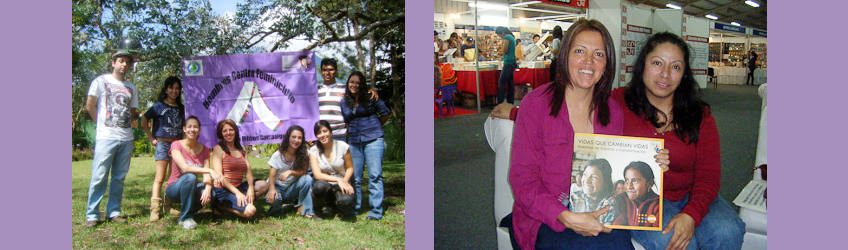
Workshop with the PNC (National Police)

I got to spend a week training inside the PNC academy. My part of the training was one full day, and there were three days of training run by the Naval Criminal Investigation Service (NCIS). What an experience!

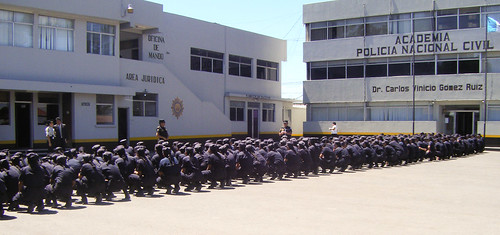
In the Yard
Outside the Police Academy buildings

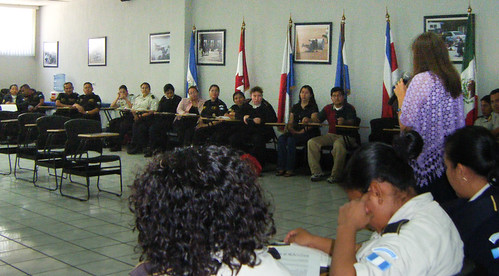
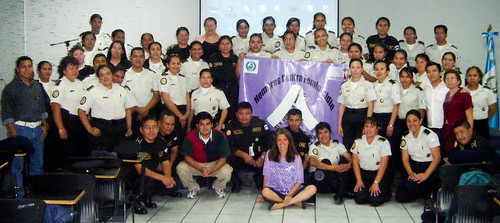
Last November, we asked our U.S. Ambassador to Guatemala, Steven McFarland, to help us get in the door to help train the National Police (PNC). As a result, MIA was invited to tag along with NCIS during already-planned training to deliver our program “Hombres contra Feminicidio” aka White Ribbon Campaign. We want to thank the ambassador for the opportunity to speak to a classroom full of 60 trainers, and we’re very proud of how the training went.

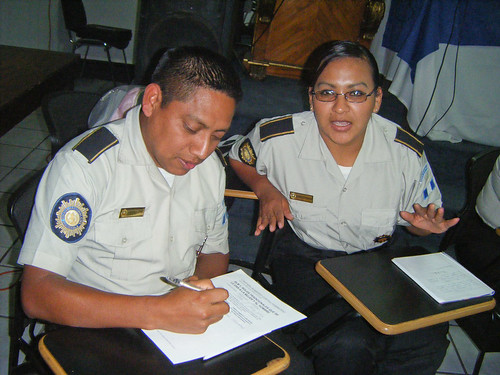
Partners
Students working together on a workshop assignment

While MIA was in action, the director of police academy joined us in the middle of an activity and without knowing who she was, I used her for an example and she volunteered without introducing herself. She was a good sport and played the role I asked her to, and after the activity was complete, one of the trainers came to me to ask me if I knew who she was. I did not know and she explained that she was the director. I immediately acknowledged her and asked her to join me in the middle of our circle and asked her if she could stay longer to hear the trainers request, complaints and wishes. I was assertive with her, just like back in my Girls, Inc. days when I had to be assertive with the high school administrators during our training with their students.

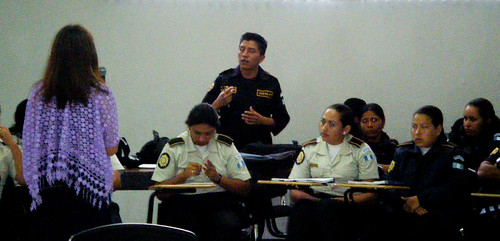
Lucia leads the workshop
Lucia leading the workshop

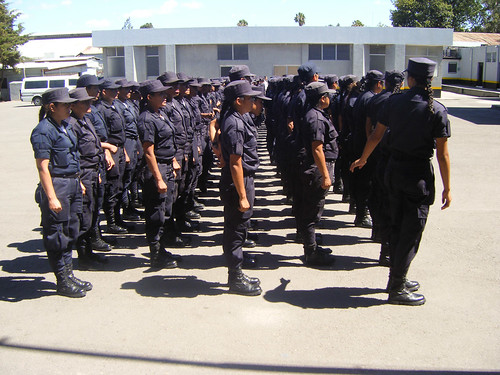
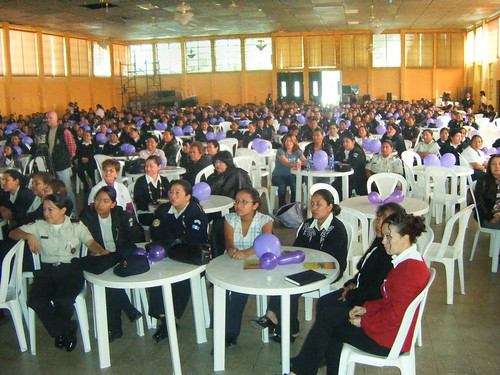
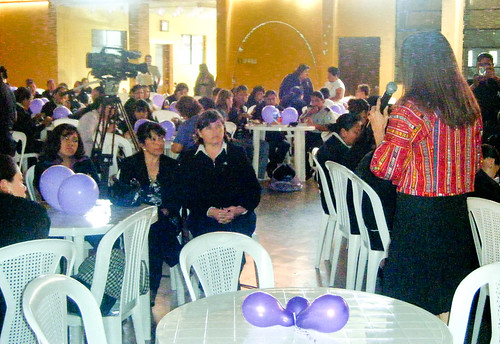
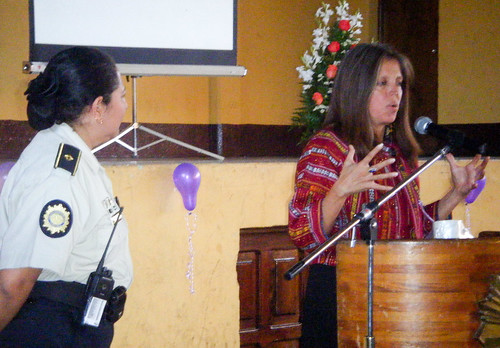
She was very open and thanks to our moves, she liked our work and invited me to give an inspirational talk on Women’s International Day to 460 new policewomen who are about to graduate.

Participation
Students engaging in the workshop

I really wanted to have a male join me for the training, and luckily Carlos Ibanez, who has spoken to our delegations about human trafficing, recomended his buddy Eric who is a long time trainer for teenagers and Eric jumped on the opportunity. He is “between jobs” and our small honorarium meant a lot to him. I am hoping we can afford to have him do more training with us in the future.

I want to tell you more about the training.

My fellow trainers from NCIS came with a 3 day training of a translated domestic violence manual and walked the PNC through page by page for three days. The material seemed pretty basic. But while I was observing the first day, I figured out that NCIS had done their homework; they knew that we need to get our police men to understand their own biases on how to respond to a call for help. The first day was spent tapping into their biases and help the police women to be respected. What the NCIS trainers did not realize in advance is just how bad it is for the police women in Guatemala.

Directors
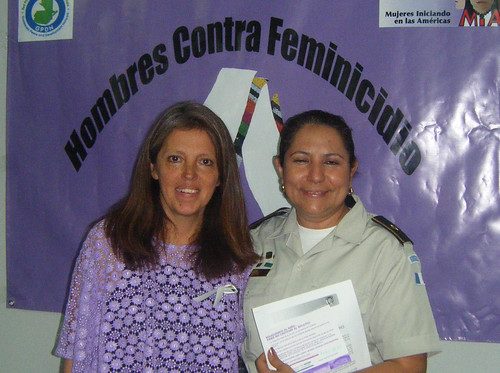
Lucia (left) and the Director of the Police Academy

One brave companera stood up and gave her own testimony on how hard it is to be a police woman. She and her coworker were sent to respond to a call and found a body hanging, she spotted from a distance and ran to the body, prompted her coworker and he responded to her; “you found him, you get him down.” She had to pick up the body from hanging untie him and them put him down without dropping him and hurting him more. My fellow NCIS trainer’s question was, “did you go to your supervisor?”, a very common question we here in the U.S. would expect to do. The policewoman responded very assertively, “No”. The trainer asked why, and the policewoman explained to her, that reporting a thing like that can only get her in trouble. The policewoman explained how hard they have to work to prove themselves all the time, and how it affects the concentration during their duty. Not only do they have to watch their back against the suspects when responding to calls, but also with their male coworkers.

They reported that they are not allowed to drive during a call. We women are seen as bad drivers and not aggressive enough to zig zag thru Guatemala’s crowded streets. In one of our conversations during breaks, the NCIS women talked about our policewomen sisters in the U.S. going through the same kinds of things in the 1960s and 1970s. Probably, this is still happening still here at home but less visibly than in the early days, and much less visibly than in Guatemala.

Over and over, our NCIS trainer ended up giving the same lesson, if you reach a roadblock, you find a way to go over it, around it, or under it, but reach your goal. Guatemala women and men don’t have the equipment to go around it, under it, or over it. Many times I felt the training was a teaser because they were given a training, but no assurance of a follow up to support the advice they were given.

Graduation

On Friday, after four days of training, the students got our certificates, and we got a certificate of appreciation plus PNC souveniers.

By popular demand, we were asked to go back in the summer. We don’t have exact dates, but thanks to all of you who donated to MIA for this trip, we definitely have a foot in the door with the PNC. For the next training, I did assertively ask Uncle Sam to please write me in the budget. I reminded them we are a small nonprofit and how hard it was to find funds for this past trip. Our contact person at the embassy seemed to have some ideas on how to get us funding help for the next trip, but that’s not for sure. We’ll have to see when the time comes whether Uncle Sam can fund our trip expenses, or if we will have to ask you all again for donations to help with trip costs.

I will be making a family visit to Guate soon for my favorite nephew’s wedding and will stay a few days extra to help a trainer in the city with her training skills. Many of the trainers asked me if I was going back soon, offered to help a group of eager to learn more women and one man, who impressed me, asked his boss to allow him to attend this week long training during his vacation time. His boss asked him, why would you want to give up your vacation time for a week long training and he answered him, just because. He shared with me, he did not want to explain himself, because he knew machismo is so ingrained, it was no use to try to explain the importance of this training.

It is for people like the women and this man who came to me for more information, that I knew it was necessary for us to be part of this training last month. I am planning to deliver three full days of our Hombres Contra Feminicidio training to a small group in a PNC station in Zona 1.

Ten-hut
Policewomen at attention

International Women's Day
Addressing policewomen in training on International Women’s Day

Women's Day

Inspiration
Lucia at the lecturn, with the Director of the Academy

I have a feeling we will be contacted to visit other stations and will have a chance to do more thorough work. What they want is more one to one attention, and this will help MIA understand better the ins and outs of the PNC. My hope is that we can find a grant for this leg work. I don’t want to take money from our small pot for the three schools where we are delivering programs. Also, we need to find money to translate our manuals. The little we did translate was pure volunteer work from our star Daniel from our sister organization GPDN.

I am happy to communicate that MIA was part of the end-of-week debriefing and follow up with the trainers suggestions to the Director of Police with NCIS. During the debriefing I made the case that if we want to find out if what we did this week worked, we must follow up with the same group and hear them report to us in a couple of months. During this debriefing there were many talks of coming back, but I felt that we need to follow up or else we would only be putting one fire off and running to another and another. NCIS was very humbled by the 60 trainers and we could see their trainers got emotionally involved, and also suggested they want to go back to Guate. I reminded them of all our conversations with the trainer before and after training hours and how important it is to follow up with this group.

I am calling this our pilot program. I don’t doubt we helped them, but really, we just scratched the surface. There is a much much more work to be done. I tried very hard to be assertive and talk about the impunity in my country with NCIS, but was told that that is not something they can help with.

Our goal is to continue going to the Police Academy and promoting the gender equality education until the Academy adopts gender equality education as part of its curriculum.

Analizarán cuentas de implicados en asesinato de monseñor Juan Gerardi

POR CORALIA ORANTES
496504_101
El Ministerio Público (MP) investiga las cuentas bancarias de por lo menos tres personas que aún se encuentran en investigación por el asesinato de monseñor Juan Gerardi Conedera.

El fiscal Jorge García informó que ya quedó en firme la sentencia contra cuatro personas que fueron halladas responsables del asesinato del obispo, lo cual abrió la opción de investigar a 12.

Entre los investigados están Rudy Pozuelos Alegría, ex jefe del Estado Mayor Presidencial (EMP); Francisco Escobar Blass, ex segundo al mando del EMP; Eduardo Villagrán, ex jefe de Servicios de esa dependencia; René Alvarado, quien fungía como secretario del EMP; Julio Meléndez y Darío Morales, agentes que llegaron a la escena del crimen.

Entre las pesquisas también se tomó declaración de algunos testigos.

http://www.prensalibre.com/pl/2009/marzo/03/298963.html

Police Training

Well, it’s official! Lucia will be going at the end of February to deliver our “Hombres Contra Femicidio” training curriculum to the Guatemala National Police training staff. The ambassador asked us in November how he could help us, and we said “take us to the police” to get our training in with the PNC, and he said “you got it”.

Well, of course we couldn’t believe things could happen so fast, but we met with an NCIS representative with the Embassy in January, and he said he was programming the training for the end of February. We still couldn’t believe this was all happening so fast, but we got confirmation last week, and Lucia’s booked to travel real soon.

Wish us luck!!