Tuesday, July 14

(more to come, including photos)

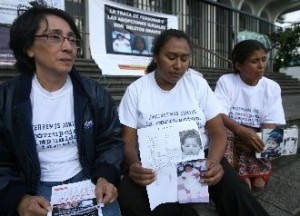
At the beginning of the day, MIA received visits from two surviving parents of murdered women. The first parent who visited us was Rosa Franco, whose daughter Maria Isabel was killed in 2001, at age 16. Maria Isabel worked in a clothing store and noticed a man that seemed to have been stalking her on numerous occasions. One night, leaving from work, she was abducted and forced into a car, and was severely beaten, raped, and left in a ditch to die.

Maria Isabel, a beautiful young woman, enjoyed wearing makeup and cute clothing. This, according to the public defense attorney, meant that she must have been a prostitute. After over a year of frustrating attempts to further her daughter’s case, Amnesty International helped Franco get her case into the InterAmericas Court. While Franco says that Amnesty International was helpful pushing her case, she said that that the IAC had its own special political interests connected to Guatemala and thus failed to push a legitimate investigation of her daughter’s murder. As a result of Franco’s determination to obtain justice for Maria Isabel, she has been subjected to various threats and the IAC has provided her family with its own security. Without any satisfactory progress to note, Franco is still trying to push her daughter’s investigation, much to the displeasure of the Guatemalan government, she noted.

Shortly after, Jorge Velazquez met with MIA to discuss the murder of his daughter Claudina, who was raped and murdered while walking home from a party. In a similar fashion to Maria Isabel’s case, Claudina’s murder was delegitimized by the police and the public defense attorney. They insisted that she must have been a prostitute due to the facts that she was wearing sandals, a choker necklace, had a navel piercing, and her body was found in a middle class neighborhood. Consequently, as a “prostitute,” her case was not worth investigating.

Claudina’s fingerprints were not taken at the crime site or at the morgue. The police immediately covered her body, even before the crime scene investigators arrived. There were also major discrepancies surrounding her time of death. Velazquez has been trying to push his daughter’s investigation for several years to no avail, but believes that his daughter’s brutal murder is a result of the reality that narcotic traffickers often use women as tools in their transactions, what is believed to be a major factor of violence against women in the country. While Velazquez and his family have not been able to obtain justice to perhaps ease the healing process, he aspires for a Guatemala in which impunity does not exist to further the pain that families of victims of violence must endure.

The personal testimonies of Rosa Franco and Jorge Velazquez left a heavy air in the room; several of us were in tears. Such tragic accounts, however discouraging as we realized the magnitude of impunity that too often overpowers women’s cases, gave us even further inspiration for the cause to which we have become dedicated.

MIA then visited San Carlos University, the last public university in Guatemala. Randi and Jenny, who are long-time friends of MIA, gave us a presentation along with the rest of their on-campus activist group, Collectivo Rogelia Cruz. Giving a thorough and accurate history of the country, they discussed the military coup in 1951 that was aided by the United States and put Jacob Arbenz in power, leading to the 30-year old civil war that began in 1960 and, despite the signing of peace accords in 1996, continues to haunt Guatemala. The group also presented on the student movement that arose in the 60’s and 70’s as a result of the massive inequalities that ensued as a result of war and contributed to society’s overall resistance to the political climate. As the student movements began at this very university, Collectivo Rogelia Cruz gave us a tour of the incredible murals around campus that serve as both intricate works of art and heartfelt accounts of the country’s history.

U.S. Embassy, the First Lady, and Sobrevivientes Monday, July 13

MIA’s first meeting of the day was an 11am appointment at the United States Embassy with the U.S. Embassador to Guatemala, Stephen McFarland (“The Unusual Diplomat,” in the July 13 issue of El Periodico Guatemala, www.elperiodico.com.gt). Accompanying us was Gladys Monterrosa, the wife of the ombudsman, who was recently a victim of horrific rape and violence. In demonstration of Guatemala’s system of severe injustice for women, Gladys testified her experience and the extremely flawed investigation that followed.

During the investigation, no efforts were made to gather information or evidence from Monterrosa regarding her experience. An investigator, however, visited Monterrosa’s office and interviewed her assistant. He asked questions about Monterrosa’s salary, money spent, and call history, among other irrelevant inquiries. Additionally, the investigator asked about the office assistant’s marital status, which at the moment was single. Later in the investigation, this information was used against her to build the defense against Monterrosa’s case – the office assistant had since married, yet because she had previously stated that she was single, she was considered a “liar” in order to discredit Monterrosa’s case. Since the investigation began and was picked up by the CICIG Rincon, all of the questions asked of Monterrosa have to do with personal matters instead of details of her assault. Monterrosa noted that there has been no investigation of any potential suspects – the only one being investigated is Monterrosa herself.

As her husband was suspected to eventually run for office, some believe that successful prosecution in Monterrosa’s case would amount to sympathy for the family and result in an increase in women’s votes. Monterrosa’s brave testimony gave MIA an important opportunity to show that impunity, especially in cases of violence against women, affects even the upper class.

Embassador MacFarland commended Monterrosa’s courage and says that he has faith that the CICIG will eventually lead her to justice. Keeping in mind that Monterrosa’s tragic case is all too familiar in Guatemala, McFarland said that the solution to the profound problem of violence against women must be recognized and dealt with from within the justice system, as well as changes to the overall mindset of society. He noted the implementation of USAID to the Guatemalan government to combat impunity, as well as potential police reform – both of which, provoked by questions from two of the delegates, resulted in two more related invitations for appointments for MIA later on in the week.

MIA’s next meeting was with the First Lady of Guatemala, Sandra Colom. As we had been learning a great deal thus far about the impunity system, it was helpful to learn more about what Colom believes to be the major factors that add to such violence in the first place. She asserted that femicide and other violence is not only a problem of law, but that it is a social systemic problem that starts at home, facilitated by “machismo” culture, poverty, poor health, and lack of education.

Colom was candid in her responses. Admitting her regrets that she has been so overwhelmed with the seemingly infinite problems that plague Guatemala, she admits that she has not been able to focus a significant amount of time and energy to the issue of femicide. She discussed the new series of social programs called “Consejo de Cohesion Social,” which, according to Colom, do address what she considers to be factors that contribute to violence – particularly poverty and education. Addressing the high illiteracy rate among indigenous women, financial dependence of women on their husbands, domestic violence, the overall malnutrition of society, and intergenerational poverty, Colom hopes that as long as these programs generate results, they will continue in the coming years. She noted that the economic elite, however, will likely be the main obstacles to the success of these programs, as interruptions of the cycles of poverty and violence are contrary to their political agendas.


MIA’s third meeting of the day was with Fundacion Sobrevivientes (Survivors Foundation), an organization that works to ensure justice for women in cases of rape, sexual violence, illegal adoptions, and other crimes, as well as provides a shelter when necessary. It was founded in 1999 by Norma Cruz and her daughter, Claudia Maria Hernandez Cruz, and plays a vital role in intervening in women’s legal cases that would otherwise be subjected to the injustice of impunity. Norma, pictured above, was awarded the “Women of Courage” award this year by the Obama administration.

They essentially “make a system work that doesn’t want to work,” according to Eugenia, the assistant to Norma Cruz who spoke with us. Aside from the improbable circumstance that a woman would be able to find justice in the Guatemalan system on her own, most women with whom Fundacion Sobrevivientes works cannot afford the high cost of legal systems – so the organization provides its services for free.

Currently in the center of the foundation’s heart is the issue of illegal adoption, for which Norma Cruz told us she was planning a hunger strike. At the subject of the strike are three different cases whose scenarios are all too familiar for Guatemala. In many cases, a young child or infant may be abducted and declared “abandoned,” yet when a mother may come forward, the defense facilitating the illegal adoption claims that the mother is too impoverished to provide a decent life for the child.

In one of the cases for which Sobrevivientes is protesting, a woman had left her infant with a relative while she went grocery shopping. While she was gone, someone entered the house claiming to have been told by the mother to pick up the child, and kidnapped her for a lucrative illegal adoption in the United States. Because illegitimate procedures were followed in each three cases, Sobrevivientes is calling for legal procedure both in Guatemala and in the U.S. to void all three adoptions.

Norma Cruz, along with Sheryl Osborne – an American working with orphans in Guatemala – have both said that they are willing to starve to death in the hunger strike if all three children are not returned home. Learning about the important work that Fundacion Sobrevivientes does for women in Guatemala and the amazing strength of Norma Cruz, we gained tremendous inspiration for the rest of our delegation and for our work in the U.S. in the future.

STARTS TODAY: Curso Cátedra de la Mujer 2009

Sesión I: “Herramientas metodológicas para un currículo no sexista”

Aula Dr. Carlos Gonzáles Orellana — División de Desarrollo Académico — DDA, 2do. Nivel

Ciudad Universitaria zona 12

Salas 1 y 2 Edificio de Recursos Educativos,

4to. Nivel Biblioteca Central, USAC, zona 12

Horario: de 8:00 a 13:00 horas

Conferencia Inaugural

“Si aprendemos conjuntamente y en las mismas condiciones tendremos mejor vida.”

Herramientas para promover la equidad e igualdad de género y étnica en la escuela primaria. De primero a sexto grado.

We kaqatijoj qib´ pa junamal kaqariq junutzalaj k`aslemal (idioma k´iche`)

• Licda. Estela Soch Consultora OPS: Intercambio de experiencia

• Lucia Muñoz: Proyecto MIA en California, EEUU

• Licda. Sandra Verónica Collado: Investigadora, área de Docencia IUMUSAC

Calendario Reuniones Presenciales:

Sesión I. 16 de julio de 2009

Sesión II. 21 de agosto de 2009

Sesión III. 18 de septiembre de 2009

Sesión IV. octubre de 2009

Diploma de Participación a quienes cumplan con el requisito de 80% de asistencia y 80% en la entrega de tareas a e-mail pslucreciavicente@yahoo.com. Inscripción Lucrecia Vicente pslucreciavicente@yahoo.com.

U.S. Opens Path to Asylum for Victims of Sexual Abuse

By JULIA PRESTON / New York Times

The Obama administration has opened the way for foreign women who are victims of severe domestic beatings and sexual abuse to receive asylum in the United States. The action reverses a Bush administration stance on an issue at the center of a protracted and passionate legal battle over the possibilities for battered women to become refugees.

In addition to meeting the existing strict conditions for being granted asylum, abused women need to show a judge that women are viewed as subordinate by their abuser, according to a court filing by the administration, and must also show that domestic abuse is widely tolerated in their country.

The administration laid out its position in an immigration appeals court filing in the case of a woman from Mexico who requested asylum, saying she feared she would be murdered by a common law husband there. According to court documents filed in San Francisco, the man repeatedly raped her at gunpoint, held her captive, stole from her and at one point attempted to burn her alive when he learned she was pregnant.

The government submitted its legal brief in April, but the woman only recently gave her consent for the confidential case documents to be disclosed to The New York Times. The government has marked a clear, although narrow, pathway for battered women seeking asylum, lawyers said, after thirteen years of tangled court arguments, including resistance from the Bush administration to recognize any of those claims.

Moving cautiously, the government did not immediately recommend asylum for the Mexican woman, who is identified in the court papers only by her initials as L.R. But the Department of Homeland Security, in the unusual submission written by senior government lawyers, concluded in plain terms that “it is possible” that the Mexican woman “and other applicants who have experienced domestic violence could qualify for asylum.”

As recently as last year, Bush administration lawyers had argued in the same case that battered women could not meet the strict standards of American asylum law.

“This really opens the door to the protection of women who have suffered these kinds of violations,” said Karen Musalo, a professor who is director of the Center for Gender and Refugee Studies at the University of California Hastings College of the Law in San Francisco. Ms. Musalo has represented other battered women seeking asylum and recently took up the case of L.R.

The Obama administration’s position caps a legal odyssey for foreign women seeking protection in the United States from domestic abuse that began in 1996 when a Guatemalan woman named Rody Alvarado was granted asylum by an immigration court, based on her account of serial beatings by her husband, a Guatemalan soldier. Three years later, an immigration appeals court overturned Ms. Alvarado’s asylum, saying she was not part of any persecuted group under American law.

Since then Ms. Alvarado’s case languished as officials debated the issue, reluctant to open a floodgate of asylum petitions from battered women across the globe. In 2004, lawyers at Homeland Security broached the possibility of asylum for victims of domestic violence, but the Bush administration never moved forward with that policy.


http://www.nytimes.com/2009/07/16/us/16asylum.html?hp

Madres exigen justicia

542937_101

Norma Cruz, directora de la Fundación Sobrevivientes, encabeza una huelga de hambre que hará junto a dos madres, por la falta de justicia en procesos por adopciones ilegales.

Por claudia acuña

Norma Cruz, directora de la Fundación Sobrevivientes, comenzó ayer una huelga de hambre que no depondrá hasta que los juzgados decreten la nulidad de tres procesos de adopción con procedimientos ilegales.

Sin embargo, cuando la salud de Cruz sea afectada por esa protesta, será relevada por una madre cuya hija le fue arrebatada de los brazos y dada en adopción.

Cruz expresó: “Conforme me deteriore físicamente, una de las madres asumirá mi lugar. No nos iremos hasta que nos den la nulidad de los tres procesos de adopción”. Las menores están con sus familias adoptivas en Illinois, Iowa y Louisiana, EE. UU.

Las madres han sido víctimas de intimidación desde hace 15 días, por lo que están bajo protección. Una de ellas tuvo que ser trasladada de su casa, junto a su familia, en prevención.

En su pronunciamiento, Cruz exhortó al presidente Álvaro Colom para que el Ejecutivo tome una postura al respecto. Le exige al Legislativo la aprobación de un punto resolutivo de apoyo a las madres de las niñas.

Agregó que tiene que haber una reparación del Estado para estas madres, porque fueron víctimas de funcionarios que permitieron las adopciones de sus hijas, con documentos falsos.

Las niñas Arlen Escarleth López López, Angieli Hernández Rodríguez y Heidy Sarai Batz Par fueron entregadas a otras familias, con identidades falsas, por medio de un fallo judicial.

La Fundación Sobrevivientes solicitó que se le retire la inmunidad a Mario Fernando Peralta Castañeda, juez de la Niñez y Adolescencia, de Escuintla, a quien señala de haber participado en un proceso anómalo de adopción de una niña de 4 años.

Síntesis
Principales hechos

Las adopciones de tres niñas guatemaltecas con identidades falsas ha sido señalada por la Fundación Sobrevivientes, que exige justicia.

• Desde 2006, cuando las niñas fueron arrancadas de los brazos de sus madres, éstas han mantenido una lucha constante para determinar el paradero de sus hijas.

• La bebé Angieli Hernández fue identificada como Karen Abigaíl López García, y ahora recibe el nombre de Karen Abigaíl Monahan Vanhorn.

• Arlen Escarleth fue presentada en el proceso de adopción como Cindy García, y ahora lleva el nombre de Cindy Colwell Thomas.

• Heidy Saraí, identificada como Kimberly Azucena Jiménez, es ahora Kimberly Azucena Ocheltree.

• El 23 de marzo último, el Ministerio de Gobernación ofreció una recompensa de Q100 mil a quien diera información comprobada del paradero de Angieli Hernández.

• Tres días después se descubrió que la menor había sido adoptada por los esposos Monahan, tras haber sido declarada en abandono por el juez de la Niñez en Escuintla, Mario Fernando Peralta Castañeda.

Market in Chichicastenango, Sunday July 12


With no meetings scheduled for the day, the delegation was able to enjoy the scenery while driving from Xela to Chichi. We got to shop during the day at the most famous market in Guatemala, eyeing and buying blankets, accessories, and clothing – all of which are beautifully intricate and will help us sustain our memories of this precious country once we return home. On our way back to Guatemala City we stopped at the home of Lulu, a longtime friend of MIA, who fed us home-made tamales, Guatemala style, while we prepared for the busy week ahead.

Meeting Grupo Cajola

Justine reports: The MIA delegation drove to the state of Quetzaltenango and visited Cajola, a 500-year-old town nestled in the highlands with a population of approximately 18,000. The people of Cajola, 93% of whom are Maya Mam, still use the Mam language and are one of the oldest of people of Mesoamerica. Unfortunately, with a poverty index of 94%, Cajola is typical of the indigenous people of Guatemala.


We visited the headquarters of Grupo Cajola, an organization based in Cajola and in Morristown, New Jersey, where the group was formed in 2000 by Eduardo, a proud son of Cajola. In Morristown, Eduardo became involved in the immigrant rights organization that was founded by Karen Maxim, one of Grupo Cajola’s directors. Together, Eduardo and Karen have developed and implemented bi-national projects to help develop enterprises to benefit the town of Cajola.

Eduardo has since returned to Cajola to help his community, and Karen now splits her time between Cajola and Morristown. By implementing her knowledge gained as a former corporate businesswoman, along with her and Eduardo’s unprecedented dedication and compassion, Grupo Cajola has created continuously expanding development projects, including an egg farm, textile business, and leadership training to help empower the women of Cajola.


Eduardo’s family graciously hosted a traditional Guatemalan lunch for MIA. We got the chance to see the results of Grupo Cajola’s hard work when Karen gave us a tour of the chicken farm through which the egg business operates, as well as a glimpse into the space where the women weave their textiles.

We also took a tour of the village’s town center, which now contains a library and Internet center, along with several other important developments made possible by the support of Grupo Cajola.

MIA then met with the two groups of women who work in Cajola’s egg farming and textile businesses. The MIA members and sisters of Cajola sat side by side in a circle as we discussed the adversities facing the women of the town, the progress that Grupo Cajola has helped make, and inquired about each other’s lives as Cajola women and as Americans. Language barriers were transcended through laughter, and despite the radically different lives of the women of Cajola and the delegates in the United States, a true solidarity was formed and the MIA delegates gained enormous inspiration from Grupo Cajola and its women who are committed to the positive developments of the beautiful town.

July 2009 Delegation Starts with Claudia Samayoa

Friday, July 10, 2009, all the delegates for our SIXTH delegation to Guatemala arrived, some at 7:30 AM, some in the middle of the day, two traveled around Guatemala by themselves before meeting us in the Capital, and three arrived mid-afternoon from Texas. The Texans hardly got to breathe before we hustled everyone over to the office of UDEFGUA for a briefing of recent Guatemala history and an overview of the current situation. This report is from our delegate from Cal State University at Long Beach, Justine:

This afternoon delegates of MIA, Mujeres Iniciando en Las Americas, sister organization of the Guatemala Peace and Development Network (GPDN), met with human rights activist and defender, Claudia Samayoa, director of UDEFEGUA Guatemala (http://udefgua.blogspot.com)

Samayoa and UDEFEGUA protect human rights defenders in Central America, with a particular emphasis on Guatemala. The organization’s role is to defend human rights activists who face threats of attack and defamation as a result of challenging the government’s persistent violence and corruption that has continued to plague the country, as 2,300 out of the population of 13.5-15 million people have been killed since the beginning of 2009.

Samayoa gave the delegates an overview on impunity in Guatemala. Acknowledging countries such as the United States and Mexico in which corruption seems to infiltrate its way upward through the political system, she noted the opposite path taken in the Guatemalan system in which corruption begins at the top economic positions and works its way down through the different facets of society, as those in higher positions tend to manipulate systems into catering to their financial interests. As a result, justice for crimes is virtually impossible to obtain, as the civil (what we call the criminal system in the U.S.) system has an impunity rate of almost 100%, according to Samayoa.

Those who challenge these injustices live in a constant threat of violence. At particular risk are women, who have been pioneering the country’s nonviolent push for peace, democratization, and human rights initiatives. Attacking women activists, however, is a way to sustain the country’s corrupt system by placing women back into the home and out of work, universities, and positions through which to activate change in their country. As these women and other human rights defenders are a significant threat to organized crime, they become targets of violence. There have been a total of approximately 1,600 attacks against human rights activists, the majority of which have been initiated by some of the five different intelligence groups in Guatemala.

Addressing the situation of Guatemalan President Colom and alleged disputes with narcotics traffickers, in which attempts at investigation and a coup have been unsuccessful, Samayoa related similar situations in Guatemala to the recent coup of President Zelaya that has taken place in neighboring Honduras. While two countries’ presidents have been suspected of similar allegations, the coup in Honduras was successful due to the way in which the military made legal maneuvers to justify the coup and through elaborate and careful work with the media.

In regard to Guatemala’s progress toward justice and the tackling of impunity, Samayoa noted the commission recently established by the United Nations and the Government of Guatemala, the International Commission Against Impunity in Guatemala (CICIG), which was formed to investigate and prosecute these impunity systems. While attacks continue, however, Samayoa and UDEFEGUA are essential allies in protecting the human rights activists who challenge these corrupt systems and push for justice in Guatemala.

Víctimas en tiempo de paz superan a las de la guerra

La violencia causa un promedio de 17 muertes a diario en Guatemala, uno de los índices más altos de Latinoamérica.

La violencia causa un promedio de 17 muertes a diario en Guatemala, uno de los índices más altos de Latinoamérica.

Por Cristina Bonillo

El conflicto armado terminó de manera oficial hace 13 años, pero solo sobre el papel, ya que las cifras de la violencia superan en la actualidad las de aquellos tiempos e impiden a la población gozar de la libertad y la seguridad propias de los países en paz.

Esto, además de los constantes cambios de autoridades en el Ministerio de Gobernación, los planes de seguridad fallidos y la falta de capacidad policial, hace que internacionalmente Guatemala sea calificada como un país altamente peligroso para nativos y turistas.

Desde 1997 —luego de la firma de los acuerdos de paz— se han producido en el país casi 60 mil asesinatos de hombres y mujeres, cifra que coloca al país en uno de los peores lugares del mundo sobre tasa de crímenes, que alcanzó en el 2008 los 48 homicidios por cada cien mil habitantes

Las cifras del conflicto hablan de 200 mil víctimas y desaparecidos, según los informes de la Comisión de Esclarecimiento Histórico (CEH) y de la Recuperación de la Memoria Histórica (Rehmi), lo que señala una media de cinco mil 500 asesinatos al año. La anual de los 13 años de paz es de algo más de cuatro mil 600 asesinatos, con una tendencia al alza, lo que no supone una gran diferencia entre la paz y la guerra

La Organización Mundial de la Salud estipula como un índice normal de criminalidad de cero a cinco homicidios por cien mil habitantes al año. Las sociedades que superan este rango se encuentran en una situación de alerta y enfrentan un problema de criminalidad epidémica que requiere un abordaje especial. “Desde el punto de vista de la salud, Guatemala está enferma”, explica Sergio Morales, procurador de los Derechos Humanos

Helen Mack, de la Fundación Myrna Mack, asegura que esta es “una guerra nueva, porque prevalece el mismo terror y las mismas características de impunidad. La corrupción se democratizó”, denuncia. “En tanto las políticas de seguridad no sean del Estado, seguiremos viendo cambios como el último del ministro de Gobernación, con el que son cuatro en un año y medio. Así es imposible avanzar, no hay continuidad”, añade.

El problema también es grave desde el punto de vista económico. Una publicación del PNUD-Guatemala en el 2006 asegura que el costo de la violencia fue de Q17.9 millones, y parece que las cantidades aumentan. Según proyecciones de expertos en criminalidad, el 2009 podría ser el año más violento desde la firma de la paz, puesto que debido al ritmo actual, habrá más de siete mil homicidios, con lo cual se superarán las 17 muertes violentas diarias en promedio de la actualidad, cifra inédita hasta ahora en el país

Esta situación ha propiciado que Guatemala se encuentre en uno de los últimos lugares del Índice Global de Paz 2009, en el que se miden varios criterios para determinar el nivel de concordia en el que vive un país

Entre éstos están los altos niveles de criminalidad, el alto índice de homicidios por habitante, la facilidad para poseer un arma y la falta de respeto por los derechos humanos. La conflictividad social causa que los niveles de violencia anual recuerden los de una guerra convencional

Sandino Asturias, analista del Centro de Estudios de Guatemala, explica: “La violencia del pasado —guerra civil— fundamentalmente era una política de Estado, por lo cual se instauró todo un mecanismo de impunidad total que se mantiene en la actualidad. Si se hubieran corregido los excesos, hoy no tendríamos los niveles de violencia que tenemos”

La CEH identificó en su informe de 1999 sobre el conflicto las causas que lo generaron, las cuales aún perviven en la sociedad guatemalteca, de acuerdo con estudios actuales efectuados por entidades nacionales e internacionales; por ejemplo, el racismo, la desigualdad extrema y un sistema imperante de injusticia institucional

Otro factor importante en la continuidad de la violencia es la gran cantidad de armas que circula en el país. El Departamento de Control de Armas y Municiones (Decam) tiene registro de tenencia de 375 mil armas de todo tipo, pero diversas organizaciones creen que hay al menos 500 mil más en posesión ilegal

De acuerdo con Asturias, en 1997 se vendieron 21 millones de municiones legalmente en el país. En el 2008, en lugar de reducirse esta cantidad, la cifra de municiones vendidas superó los 50 millones para consumo interno. “Si vienes de un país en conflicto, con una justicia débil y además has permitido que la gente se arme, que la criminalidad esté mejor armada que las fuerzas de seguridad, las armas se convierten en el mecanismo de confrontación y resolución de conflictos”, refiere

El auge del negocio de las armas se refleja en las cifras de la violencia: en 1997, el 40 por ciento de los homicidios se producía con arma de fuego. En el 2008, la cantidad de asesinatos cometidos por este medio superaba el 85 por ciento.

Cultura de la impunidad

El 98 por ciento de los delitos que se cometen en el país queda en la impunidad. “Tenemos problemas irresueltos. No se ha logrado obtener un modelo de desarrollo económico y social justo y equilibrado, el fondo de todo tiene que ver con la desigualdad y la injusticia”, expone la diputada Nineth Montenegro.

La aparición de nuevos fenómenos, como el narcotráfico, el crimen organizado y la corrupción, ayuda a mantener el sistema de impunidad en el país. “Guatemala tiene que entrar en serio a librar una batalla frontal en sus diversos fenómenos de crimen organizado, desde el Estado, pero no se ha visto voluntad política para erradicar ese cáncer que se está comiendo el país”, critica Montenegro.

“Si el Estado no desarrolla mecanismos para corregir estas conductas, entonces éstas se mantienen en el tiempo. Se mata, porque no pasará nada”, opina el analista político Sandino Asturias.

¿A quiénes asesinan?

Uno de los aspectos que ha cambiado en relación con la época del conflicto armado es las víctimas de la violencia.

En aquel momento, la violencia estaba focalizada en los grupos opositores y tenía tintes políticos, pero hoy en día se ha generalizado, y los grupos de población más afectados son los jóvenes y las mujeres. Según datos de la Policía Nacional Civil y la Procuraduría de los Derechos Humanos, en el 54.24 por ciento de los homicidios cometidos las víctimas fueron jóvenes de 16 a 30 años, y el 10.91 por ciento fue mujeres. Los más de los expertos aseguran que residir en Guatemala es hoy mucho más peligroso y difícil que antaño.

De la misma opinión es Raquel Zelaya, de la Asociación de Investigación y Estudios Sociales (Asies). “Hay todo tipo de manifestaciones de peligro para la ciudadanía, y por encima de todo está la percepción, nos sentimos inseguros”, sentencia.

Postura: Tema pendiente

Raquel Zelaya, firmante de los acuerdos de paz e integrante de la Asies, señala que “los primeros temas que no se han cumplido de lo firmado en los acuerdos giran en torno a lo institucional: lo primero es la Policía Nacional Civil, que no es la institución que se incluyó en la firma”.

En el tema legislativo, Zelaya señala que una de las necesidades estriba en la reforma a la Ley de Orden Público, que aún tiene tintes de “autoritarismo”.

Otro punto es la regulación y control de los servicios privados de seguridad.

“Financiar un Estado contrainsurgente es mucho más barato que financiar un Estado democrático, que viene con sus instituciones; ahí estamos sumamente mal”, refiere.

Acerca de las cifras de la violencia, Zelaya expone que no solo se asemejan a las de un conflicto, sino que también son “las de un Estado cuyas instituciones de justicia están dando señales de mucha impunidad”.

OPINIONES

Nineth Montenegro: Diferencias y similitudes

“Antes sabíamos quién nos perseguía y por qué; ahora no sabemos de dónde va a llegar la bala, ni siquiera los motivos”, declara la diputada de Encuentro por Guatemala Nineth Montenegro, quien afirma que, aunque la situación es distinta porque obviamente se eliminó el tinte político de la persecución, hay similitudes en el peligro que persiste para el ciudadano.

Sandino Asturias: Nuevos enemigos

Según Sandino Asturias, del Centro de Estudios de Guatemala, ha cambiado el enemigo, que hoy “son las maras, los jóvenes en riesgo”, pero lo que prevalece es la mentalidad y “el pensamiento de que para acabar con el conflicto debe hacerse de manera represiva, en lugar de preventiva”.

Sergio Morales: Crueldad

El procurador de los Derechos Humanos opina que nos encaminamos hacia el año más violento en el país, y no solo en la cuestión de cifras. “Estos números demuestran la gravedad de la situación, pero es cualitativamente terrible, porque las crueldad con que se mata es terrible”, constató el magistrado de Conciencia.

DATOS

Las cifras del conflicto armado

El número de víctimas que causó el conflicto armado interno en Guatemala no se conoce con exactitud, pero las estimaciones de la Comisión Interamericana de Derechos Humanos (CIDH) indican que fueron 200 mil durante la guerra que se extendió desde 1960 a 1996. El 83.3 por ciento pertenecía a las etnias indígenas del país.

El informe de la CEH detalló 626 masacres e identificó los años de 1978 a 1983 como los más sangrientos.

Se documentaron 42 mil víctimas, aunque existió un subregistro, porque fue elaborado de 1996 a 1999, cuando el conflicto estaba muy reciente, por lo que muchas personas no se atrevieron a hablar.

Este estudio atribuyó al Ejército el 94.8 por ciento de las matanzas, y a la guerrilla el 5.11 por ciento.

Entre las principales causas que motivaron el conflicto, la CEH citó injusticia estructural, cierre de espacios políticos, racismo, institucionalidad excluyente y antidemocrática y falta de voluntad de impulsar reformas sociales que redujeran los conflictos estructurales.


http://www.prensalibre.com/pl/2009/julio/12/322470.html

Preocupa registro de violencia intrafamiliar

Por Cristina Bonillo

Las cifras publicadas ayer por el Instituto Nacional de Estadística (INE), sobre 44 mil casos de violencia intrafamiliar entre el 2007 y el 2008, preocuparon a las autoridades del Gobierno y a grupos sociales.

Las instituciones encargadas de recibir ese tipo de denuncias trasladan un documento al INE, el cual es compilado para establecer la cantidad de casos y el perfil de las víctimas y los agresores.

Las boletas son registradas en la Policía Nacional Civil, juzgados, bufetes populares, la Procuraduría General de la Nación y la Procuraduría de Derechos Humanos (PDH), y luego son trasladadas al INE.

Delia Castillo, representante del Organismo Judicial en la Comisión Nacional para la Prevención de la Violencia Intrafamiliar, afirmó que existe subrregistro.

Añadió que el Organismo Judicial recibió, solo en el 2008, 47 mil denuncias.

Esa situación demuestra que las cifras publicadas por el INE aún no registran todos los casos que ocurren en el país.

Parte de este subrregistro se debe a la falta de cultura de denuncia y a la “costumbre del silencio” que se ha impuesto, en especial, a las mujeres guatemaltecas, explicó Castillo.

Otros factores que impiden que las mujeres denuncien son la dependencia económica de éstas hacia su agresores, la crítica social y los estereotipos como que quien es víctima de agresiones de ese tipo es por que hizo algo para merecerlas, lo cual es falso y erróneo, según la funcionaria.

Castillo hizo énfasis en que esa cultura se debe cambiar.

Falta de conciencia

A lo anterior se suma que “las instituciones muchas veces no atienden bien”, señaló Castillo.

Reconoció que se hacen esfuerzos por sensibilizar al personal de las 831 delegaciones de diversas instituciones del Estado donde se reciben denuncias.

Añadió: “A veces no es fácil cambiar una mentalidad ancestral que conviene a los hombres mantener porque les da privilegios”.

Según los datos que arroja el estudio respecto del 2007, la mayoría de las víctimas son mujeres, ladinas, de zonas urbanas y que no trabajan.

El departamento donde más se registran hechos de violencia intrafamiliar es la capital, y donde menos ocurren es Izabal, aunque eso no es señal de que no haya violencia, sino de que puede haber más miedo a denunciar, expresó Sandra Lucrecia Sasso, del INE.

La violencia contra las mujeres es principalmente física, aunque empieza con la agresión psicológica, la cual no se registra, declaró Ana Gladys Ollas, defensora de la mujer de la PDH. ,

Esta institución recibió 246 denuncias por violencia intrafamiliar, de enero a junio de este año.

Sonia Escobedo, secretaria presidencial de la Mujer, dijo: “La violencia no está creciendo, pero sí está creciendo el nivel de denuncia y hay un mejor registro”.

Afirmó que en el 77.1 por ciento de los casos en que las mujeres son víctimas de violencia el agresor es el esposo, la pareja o el ex cónyuge.

Síntesis: Denuncias

Las denuncias han aumentado:

• En lo que va de 2009, la Policía detuvo a 893 personas, por violencia intrafamiliar.

•  En 2008, la cifra de detenidos por este delito ascendió a dos mil 108.

• En 2008, el Organismo Judicial registró 47 mil denuncias de violencia intrafamiliar.

•  Los jueces dictaron el último año unas 35 mil medidas de alejamiento de los agresores.

•  En el resto de casos hubo “conciliación” .

http://www.prensalibre.com/pl/2009/julio/09/326960.html